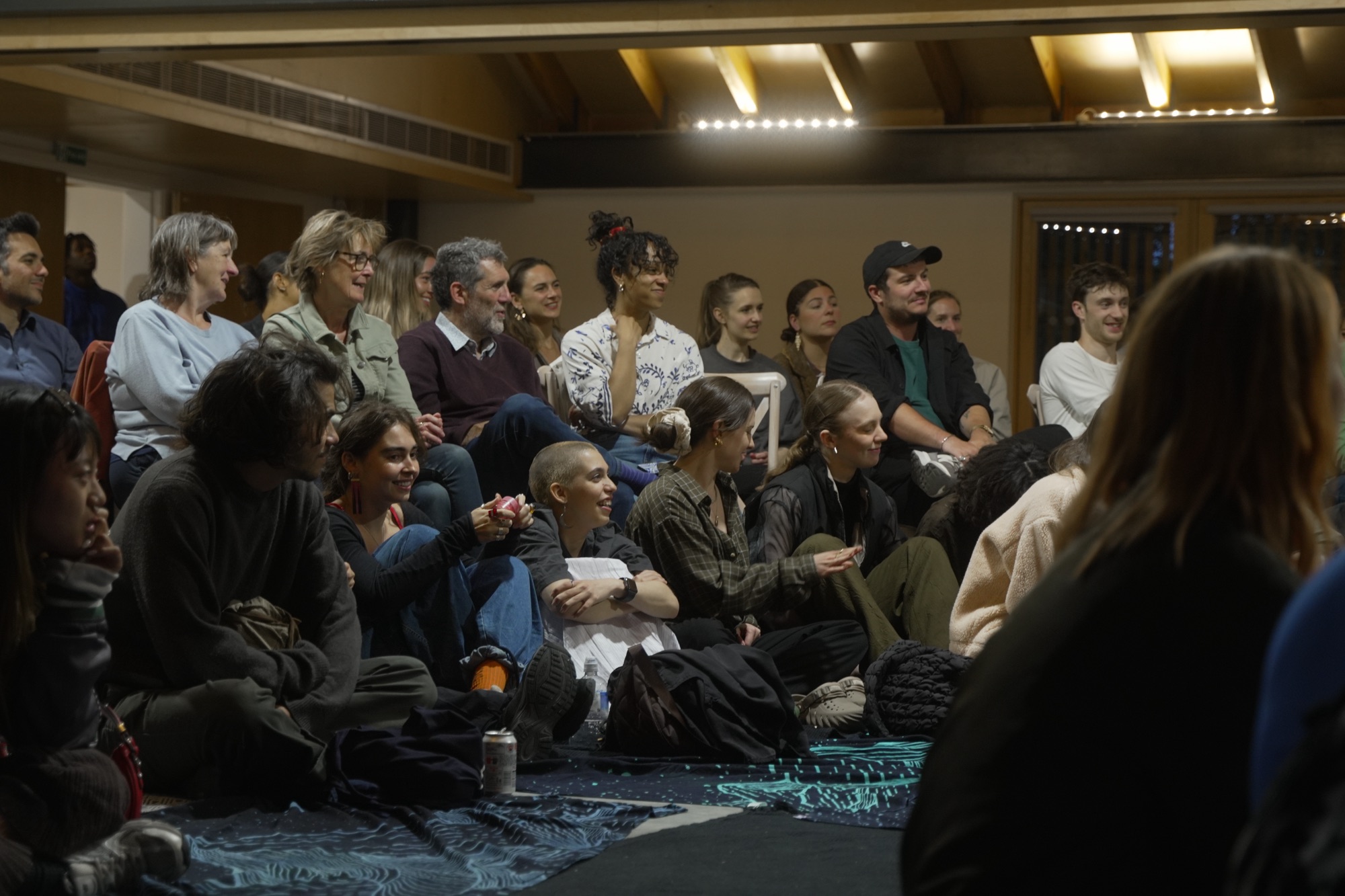
On a warm evening in May last year, as the beams of lightstretched across Hackney’s Springfield Park, a small crowd gathered for Sofar London’s latest live instalment.
Curated by Sonder Collective – a dance company brought together by British choreographer and movement director Fi Silverthorn – the performance unfolded with an intimacy that felt both deliberate and disarming.
Among the performers was Shiho Yokoyama. Where others carved space with sharp attack or theatrical flair, Yokoyama seemed to draw the audience inward. Her movement was elastic yet grounded, sensitive to the ensemble yet distinctly her own. In a work shaped by Silverthorn’s instinctive choreographic language – one that pushes street dance forms beyond convention and into more human, theatrical terrain – Yokoyama’s improvisational acuity proved powerful.
That quality of movement has been hard-earned.
Born and raised in Japan, Yokoyama describes her early life as “very ordinary”. After graduating from the Japan Women’s College of Physical Education in Tokyo, she began working as a PE teacher while simultaneously pursuing dance opportunities. That duality was difficult, but necessary. “Making a living is something every human being needs to do, but juggling side jobs alongside dance created a contradiction when introducing myself as a ‘dancer’,” she says.
At the root of her movement is a strong technical foundation. In 2018, she won first place at the ICU World Championships in Florida, marking the first time she was noticed on an international stage. She also claimed first place at the prestigious Conjazzdance battle, earning recognition within competitive freestyle contexts where spontaneity and musical intelligence are tested in real time.
These victories speak not only to technical precision but to adaptability – two qualities that define Yokoyama’s work to this day.
Drawn by a long-held desire to live abroad, Yokoyama moved to Sydney in 2022 – without speaking English. Although there were many beautiful moments, that period brought challenges that made her question her path.
“I struggled,” she acknowledges candidly. “The language barrier, the cultural shock, and even wondering why I was dancing at all,made it a very difficult period.”
But it was that period of doubt that made her arrive at a realisation that would stick with her for good: “I dance because I want to connect with people.”
That conviction would later propel her to London. Framing hermove to the UK as a final test of commitment to dance, she set herself a two-year deadline. If she could not sustain herself through dance alone, she would return to Japan and step away from the profession.
It was, by her own admission, a leap of faith. But the gamble paid off.
Now permanently based in London, Yokoyama splits her time across performing, teaching and battling. She has taught in Japan, Sydney and across London studios, encouraging dancers to “think through the body” and transform their imagination into movement– reflecting her belief that dance is an embodied form of dialogue.
Meanwhile, her performance portfolio is growing rapidly. Beyond her appearance at Sofar London, Yokoyama has featured in commercials for world-famous brands including FANTA and Amazon Prime, and contributed to cross-disciplinary creative projects such as the Global Moves Project led by Kino McHugh, where she serves as assistant and core support member.
Across all those settings, Yokoyama’s versatility – which spansanything from tightly choreographed theatre shows to freestyle acts – has made her an invaluable performer. Sonder Collective’s debut at Sofar London, which was largely contemporary-based,offered a particularly compelling snapshot of that versatility.
Silverthorn – whose own career spans arena tours, West End shows and hip-hop theatre with UK company BirdGang – createspieces that demand both stylistic command and emotional vulnerability. Yokoyama met both those requirements with utterprecision.
There is something compelling about watching a performer who does not seek to dominate space, but to elevate it. Yokoyama’s strength lies in her capacity to hold stillness powerfully, suggesting narratives without overstating them.
February 2026 marked another milestone in her high-flying career, as she joined the Prologue company of the much-acclaimed musical Cabaret at the Kit Kat Club in London’s West End – underscoring both her technical ability and her growing recognition within the UK’s performing arts scene.
For an artist who once questioned whether she could legitimately call herself a ‘dancer’, this feels like no mean feat.
“I truly feel that I could not have survived on my own,” Yokoyama reflects. “The dance industry can be tough at times, but the people you meet along the way become your support network. We stand alongside one another.”
In a city like London, defined by cross-cultural exchange and hybrid artistic practice, her journey from Japan through Australia and all the way to the UK stands as a testament to resilience and adaptability. As the old saying goes: where there’s a will, there’s a way.