Words by Georgia Howlett.
Yewande 103 is a Black, disabled-Led, parent-led dance organisation. The company brings live work to London for the first time with Many Lifetimes, a poetic, dance installation created and premiered back in 2024. We sat down with Founder and Artistic Director, Alexandrina Hemsley, ahead of Yewande 103’s performances to discuss the body in flux, accessibility and why audiences can benefit from slower paced dance.
Q: In your words, tell us a bit about Many Lifetimes?
A: I really wanted to speak to all the different lives that we carry in our bodies. Dance is such a beautiful vehicle to be expressing all of those parts of us.
I had made group work before that had been filmed, and so I was also really excited to bring that onto the stage again. And I had been really affected by a lot of personal loss and bereavement, and quite profound change in my health, or in different dance spaces that I could occupy. I had been processing that through a lot of solo work, solo films, creative writing, and some performances, but what became really apparent to me was actually wanting to then process some of these themes within a community, and use a group of really experienced, fantastic dancers and improvisers to see how we each navigate that.
It’s so universal, I really feel like we need to navigate those kinds of themes differently, but also gather together and build community around them so that people don’t feel so isolated in those moments.
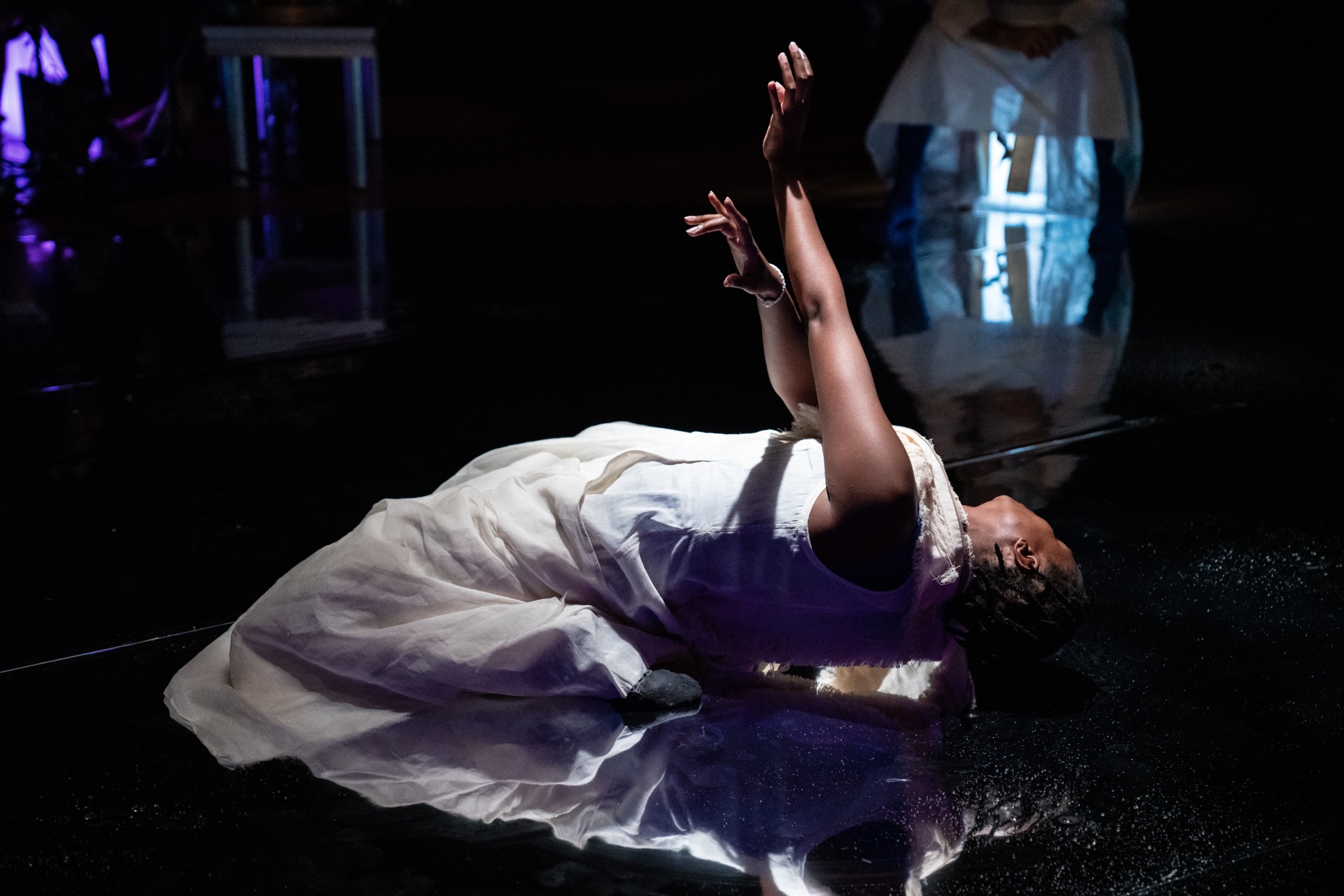
Water plays a big part in the work as well. I’ve been using watery metaphors and frameworks in my practice for about 10 years now and it’s the first time I’ve used ice, it kind of melts overhead. Then there’s this mirrored floor that’s very reflective. And so, there’s a lot of that symbolism aroundwhat water holds, particularly for people of colour, but also Disabled people and even feminism, different ways of being watery in the patriarchy. Being more fluid; fluidity is really important particularly for how we process our emotional landscapes.
Q: The piece was first performed in 2024, so a few years have passed, which I think is interesting considering this is a piece about change and transformation, all of which we experience in flux. Do you feel that the piece is always evolving and developing?
A: It really is, and I think that’s part of the process of improvisation anyway, right? So, even in the hour and 15 minute score so much change is being engaged with moment by moment, as we improvise. And as a cast, we’ve all gone through another two years of change. We’re also performing it in a really different, well, not quite so different, geopolitical landscape, the swinging to the right, and the more wars and the more genocides and more climate change. The multiple crises seem to have also deepened. And again, when we’re talking about gathering together and when we’re talking about loss and change, I guess there are just all of these urgencies and they’ve been very present in the rehearsal room.
As performers, there’s now a cast of five of us that are performing this time and those of us who’ve had kids, our kids are older, those of us who have caring responsibilities, that’s different. Even funding landscapes are really different for making work and there’s a lot more precarity around in that way. It has felt really moving that people have stayed so committed to the project, even while we’ve had to wait for funding.
In the work, each person’s solo responds to a moment of change in their lives and I’ve said in the studio about using the same material from two years ago, but also bringing a tracing paper on top of that score so that you can bring things that are more present for younow. That’s a really nice way into still staying true to what we have built in 2024, but giving room for how thematerial sits with you now.
Q: How did you and the dancers go about tapping into your personal archives for this piece?
A: We did it with a lot of care. What was fantastic about the one of the commissions we got in 2024 was that we had four weeks to rehearse. It meant I could go really slowly, actually, and I know that in Europe and bigger companies, six weeks is the minimum, but for the independent UK scene it’s quite rare.
Being a black Disabled dancer, there has been, historically, a lot of taking, or wanting to capture some of those identities and really narrow them down for consumption
– Alexandrina Hemsley
We did a lot of improvising that was quite abstract in preparation for going a bit deeper. Again, that’s why water was such a good metaphor, and working with states like opening, spilling, gathering, they’re action states, and you can apply them to your anatomy as much as you can apply them to opening up into a very personal memory.
I set tasks around moments in your life that have changed you, always saying, with a level of care, that you have agency over how deep to take that, or what that scale is, so that nothing felt extractive. I’m so mindful, being a black Disabled dancer, there has been, historically, a lot of taking, or wanting to capture some of those identities and really narrow them down for consumption. So, I was really trying undo lots of those harmful ways of working.
We worked with a lot of movement and then some creative writing around that, and then again, transforming people’s stories that they had written into these landscapes, like turn your memory into an object, turn your memory into a landscape, so again, there’s this kind of abstraction that I think protects, it means you can go very personal, that what you’re dancing, yes has your memories, but you’re also dancing with a texture, you get to make composition. I think I’m also really clear that even when things are very personal, I’m not showing my diary or my little voice notes to my friends. It’s composed, it’s a piece of choreography and that feels important to keep stressing, that we’re there, we’re working on something rather than spilling our guts out.
Lots of material that hasn’t made it into the piece was also really around this personal archive, like pick a moment or pick a year in your life that held some joy, and we would share that with each other and dance in the studio with each other’s memories, which also felt really fruitful.
Q: Yewande 103 is a strong advocate for inclusion and accessibility. What does inclusion mean to you when you are in the role of directing?
A: I think inclusion is really tidal, very watery in that it continually needs to be attended to. I really try to see access as this ecology of need because there are so many reasons why someone maybe does identify with having access needs, and also doesn’t. There are so many cultural barriers to thinking that the rehearsal studio is somewhere we where you can get what you need, and particularly when historically as dancers, we’ve been kind of trained to not take any of that into the studio, and just push.
A lot of that history is in the space even before you walk in, so to say, look, you don’t need to leave stuff at the door. How are you even going to get to the door? Do you need a travel buddy? Do you need a taxi? I guess it’s these questions, thinking through as much as I can, as much as it’s within my remit, what is someone’s entire workday? What do people need to get into the space? What do we need to be able to work?
So, in some ways access is also quite practical. Inclusion needs practical steps taken. It needs constant communication, and it does need money. That is also something that I try and take to every venue and every partner that we that we work with, what is your access budget, or even what is your audience development plan around including communities who feel barriers around their health and Disabilities?
Space to make mistakes as well. I feel like there can be a lot of defensiveness still around access when it is ever evolving. And of course, there are basics that need to be met, but I’m thinking particularly in the rehearsal space where everyone is Disabled or neurodiverse or has long-term health conditions, in those spaces, space to make mistakes. And also know that there will be these ‘access conundrums’, which is a phrase I first heard used by a Theatre Maker and Scholar, Nina Mühlemann. We were doing some work together in Zurich and I was teaching as part of a residency for Disabled artists. Someone needs a guide dog, and someone else is allergic to dogs, how do you work together in that space? You do it through communication, and you do it through asking, how do we solve this together?
There’s such a strength in Disabled led spaces where there’s a lot of interdependence and a lot of community building that’s just happening, and that needs to happen because we’re working in inaccessible spaces mostly, you know? It’s a lot of problem solving.
Q: What are your hopes for Yewande 103’s premiere in London?
A: It would be really nice to make more live work again. This would be really fantastic. We are going to do a version of this out outdoors in Italy, as part of a festival near Turin, that’ll be in May. I’d also love to stream the work so that people who can’t get to the theatre can still experience the work, so I’m making very pencilled plans to see if we can turn it into a film or some kind of livestreamed experience as well.
A couple of years ago I was also running workshops for bereaved parents, and I think I’d really like to find a way of folding in more of the wider community and engagement with the project again, through grief circles and working with people around how they navigate change.
Q: Many Lifetimes feels like a gentle invitation to immerse yourself in an intimate, healing space. Why do you think dance of this kind is needed today?
A: We’re all carrying very tender things at the moment, mostly. Especially within arts and culture, I think there’s so much precarity, there’s so much competition, so much demand on artists and audiences to be really ‘on’ all the time or balancing many parts of our lives.
We’re also either really isolated from each other or really divided, politics is just flinging itself outwards away from any kind of common ground. I think there’s a lot of fear, there’s a lot of sorrow and I’m just speaking from my own experience and from what I’m seeing impact those I care about around me, both personally and professionally. There’s a lot of speed and a lot of pressure and a lot of needing to know things quite concretely, needing to know exactly what something’s about or exactly what you’re going to do with your whole entire life. All these uncertainties, I guess.
And I wonder, particularly, in a really uncertain, ever-changing world, how do we hold uncertainty? How do we get better at holding uncertainty? That’s my invitation, to take a deep breath and let out a collective exhale before we recharge, to do the work that we all need to do.
So much does need to change. I want to invite a sense of building through that together, or at least learning how to see each other. I think this is also why the piece is slow, it’sso we can notice the detail of people’s experiences, particularly maybe people who don’t have the same experiences as yours, you know. How do we work across difference?
Many Lifetimes comes to Lilian Baylis Studio, Sadler’s Wells from 26-27 March. Book here.