Words by Qiao Lin Tan.
It seems to me that Elaine Mitchener’s body never fully belongs to herself in Graffiti Bodies XV, a piece responding to Jean Michael Basquiat’s artwork La Hara (1981) which is a slang word for “police” amongst New York’s Puerto Rican community. Commissioned by Certain Blacks as part of Black Athena Festival, Graffiti Bodies XV was choreographed by Dam Van Huynh and developed in collaboration with Elaine Mitchener and Michael Picknett.
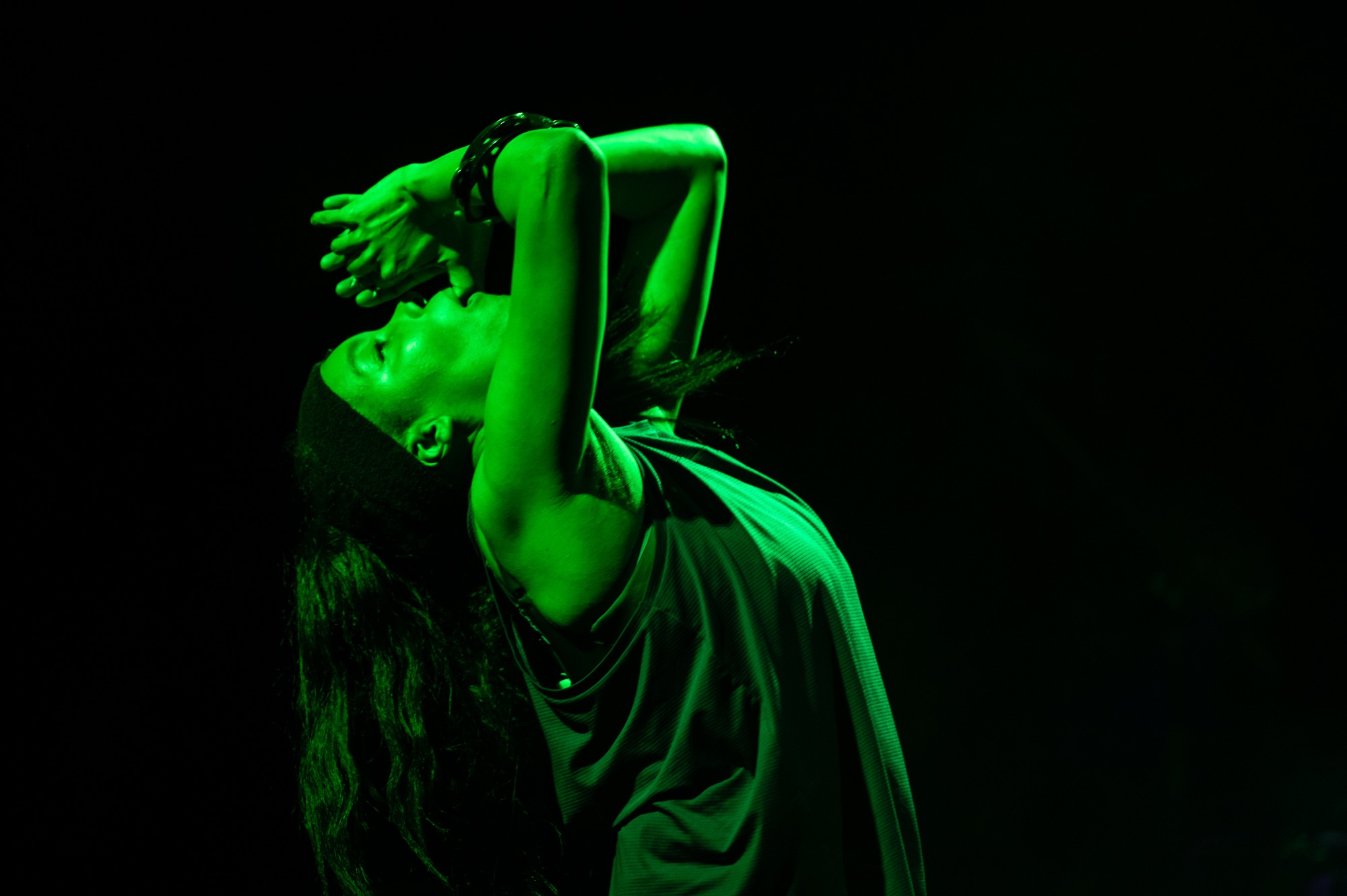
In one sequence, Mitchener’s Black body is tense and straining and contorted, a marionette doll moving of its own accord. Mitchener is sweating and breathing heavily (we hear every throaty, shuddering breath amplified through the microphone she wears) as she struggles to get words out. Her marionette body forces her arms behind her back, leaves her shuddering on the floor as if tasered, and covers her mouth – images of police brutality.
In other sequences, Mitchener puts on a performance for the audience. She gyrates whilst playing a tambourine, the metallic sounds of the instrument looped around her wrist reminiscent of the clanging of iron chains on slaves. She performs Beyonce’s Single Ladies dance over and over and over, popping her chest whilst flipping her wrist in the iconic dance move and flashing an over-the-top smile. The sequences in this piece repeats and repeats and goes on for a long time. You want her to be able to stop, to move on to the next thing, but she doesn’t. She can’t.
Her body rebels against her, silencing and immobilising in the repetitive loop it creates – always moving but never moving on. The body is the site of oppression and external control; it doesn’t belong to her. But despite the policing of the body, the spirit refuses to be silenced. On the floor, struggling to speak, against all odds she gets the words out: Self-love.
As she shakes her tambourine provocatively over her crotch: There are ways to use the body as everyday acts of resistance.
Whilst stuck in the repetitive hell-hole of the Single Ladies performance: The world is big and bright and round / And it’s full of folks like me / Who are black, yellow, beige, and brown.
Even though she’s the one being watched and her body doesn’t seem to be her own, her eyes! She returns the audience’s gaze, steady and unyielding and unshakable, even as her body rebels, and the words flow.
Her uttered words are mined from an eclectic mix of sources, as stated in the show’s libretto – artists, musicians and scholars like Nina Simone, Jean-Michael Basquiat and Audre Lorde. These fragments of text layer on top of the repetitive copy-and-paste-paste-pasted images of police violence and performance like a collage, a choice inspired by Basquiat’s artistic style in La Hara.
On top of the movement sequences, another collage is being layered. On stage is a sound board, a microphone, and in the air a pulsing beat. Mitchener acts like a DJ behind the table, jamming to the bass music and frantically jabbing the sound board buttons hooked up to various electronic sound effects. Into the microphone she vocalises guttural, fragmented, twitchy, shuttering sounds.
Like a DJ, her soundscape controls the room. At one point, she blows – so hard – into a whistle repeatedly. At another, she sounds into a microphone with a looping pedal attached: operatic scales at first, then further layered on top with throaty sounds that fracture, buffer and cut off pre-maturely. The beats, electronic sound board, operatic singing, vocalisations – it is discordant and jarring and so loud, a total sensory overload. Moving laser lights in the dark studio theatre really add to the overstimulation. One could look at the cacophony of colours, textures and images in La Hara and visualise this soundscape that Mitchener is orchestrating.
Strangely, one does get used to it eventually. It worms its way into your ears and fills you up until you’re full to the brim, almost like getting swept along at a club or a rally, until you don’t know where you start and where the sounds end. The pulsating beat of the bass, constant and repetitive, or that elongated opera scale – you feel it in your heart and deep in your brain.
When the silence arrives, it is strange and it tastes sweet. The stage lights swing hypnotically back and forth across the stage like a pendulum, and Mitchener appears and disappears with the light. There isn’t really a clear resolution to Graffiti Bodies XV – like the contents of the piece, the work is a repetition of sequences that repeat fragments of movements, sounds and texts that gradually form layers. It is constant and oppressive, but you can’t take your eyes off it. Despite everything, there is also that glimmer of hope and dignity that constantly and repeatedly appears and reappears. In a world where it feels like injustice and oppression repeats itself in different guises with every news story and social media post, Graffiti Bodies XV reminds us that amongst the multiple layers of shittery, there are always layers upon layers of hope, justice and community to look for as well.
As her marionette body is contorted into strange angles, Mitchener slowly but surely voices out the names of people who have been murdered at the hands of police brutality: Joy Gardner, Roger Sylvester, Mzee Mohammed-Daley, Ian Tomlinson, Mark Duggan, Chris Kaba, Leon Briggs, Kevin Clarke, Mikey Powell, Kingsley Burrell, George Floyd, Breonna Taylor, Rodney King, Tamir Rice, Walter Scott, Freddie Gray, Kayla Moore, Leyleen Polanco, Rekia Boyd, Michael Stewart, Oury Jalloh, Ali Ziri, Wissam El-Yamni, Lamine Nieng, Sheku Bayoh, Albert, Ojwang, Mahsa (Jina) Amini. As it has always been, a voice for justice and freedom will always arise in the face of oppression.