Words by Eoin Fenton.
The dance festival Fest en Fest returns this year showing the full range of what choreography can be. This year’s edition brings the Norwegian duo Marte Sterud and Ann-Christin Kongsness to Brighton, London, and Colchester with their ongoing project Butch Tribute.
The tribute brings the long-ignored butch lesbian figure to the centre of the action, giving audiences a chance to see stories that are otherwise left out of the canon of contemporary dance. I spoke with the pair about all things flannel, flirting, and fluid ahead of their arrival to England.
This conversation has been edited for clarity.
Q: Tell us a little bit about Butch Tribute.
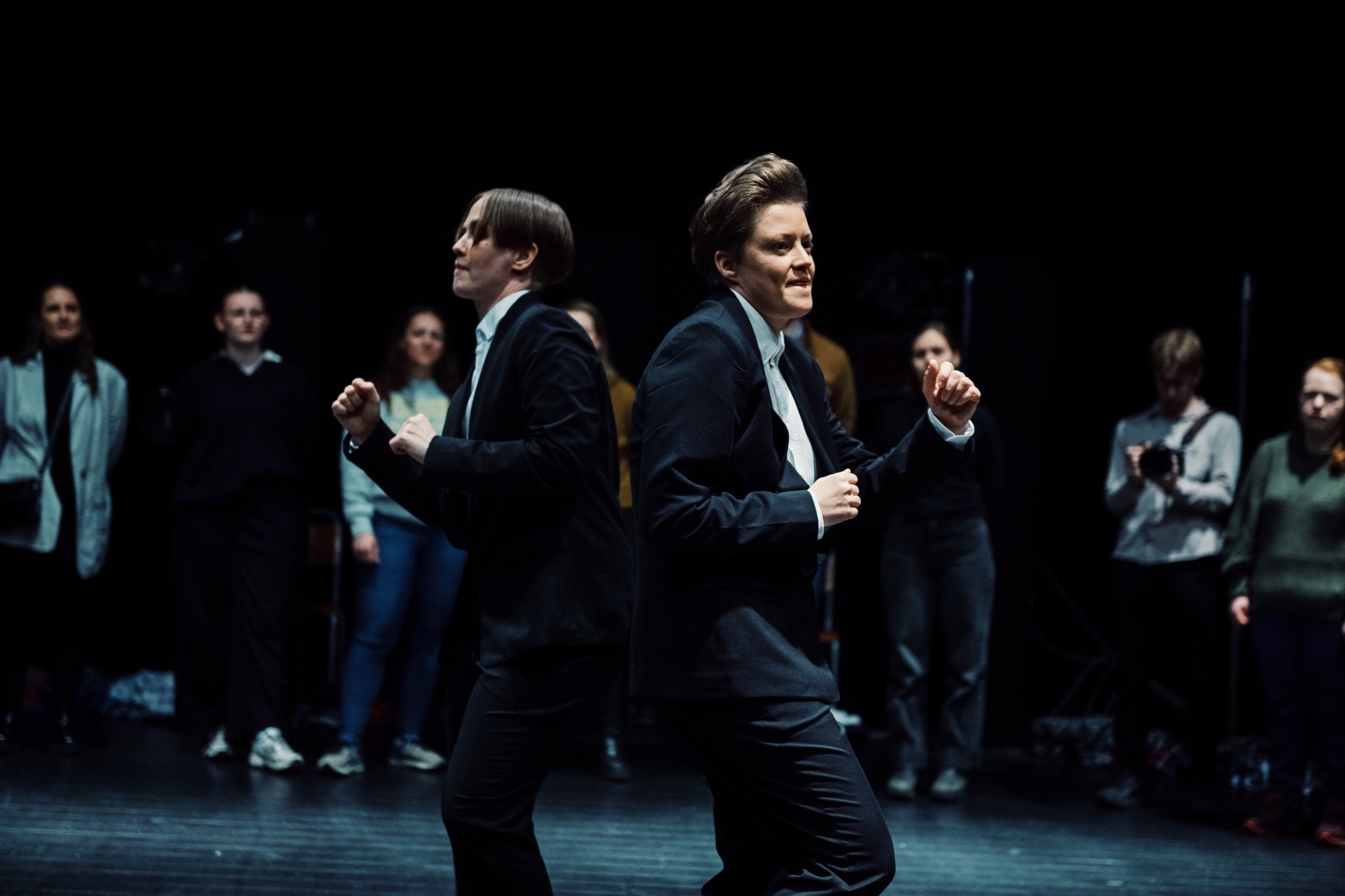
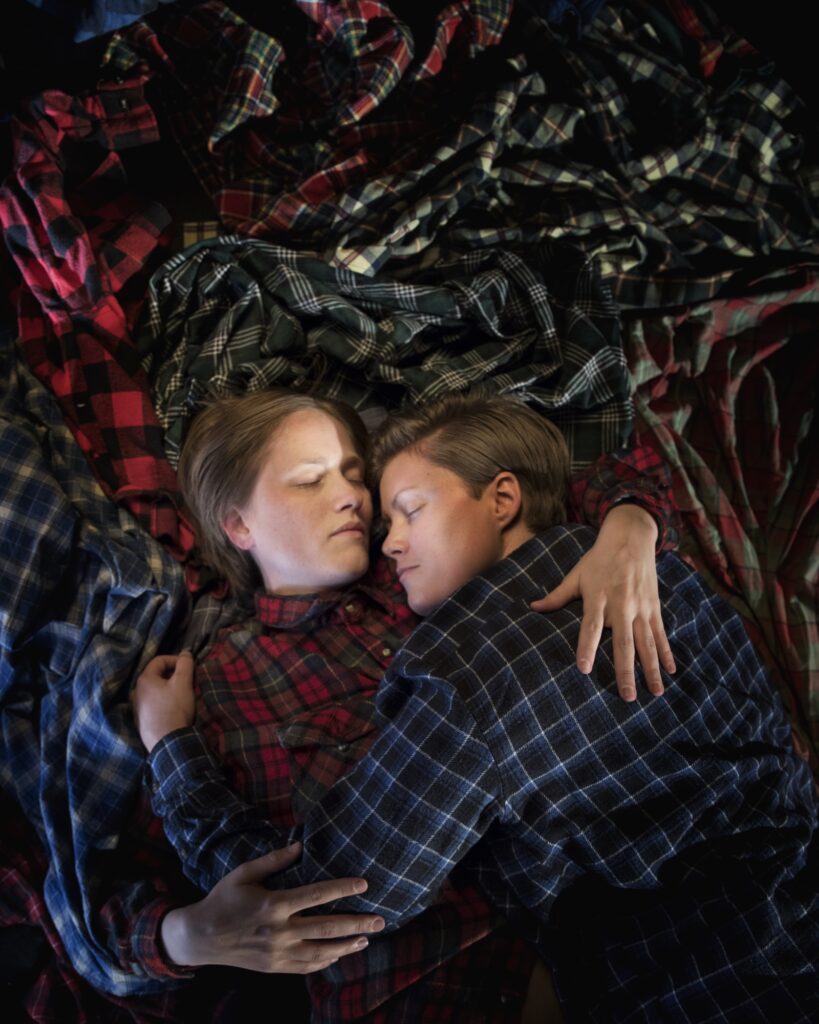
Marte: It’s a celebration of queer female masculinity, it wants to diversify the representation of butchness and show its different manifestations, and it consists of three pieces. In ‘Flirt’ me and Ann-Christin are in the middle of the space and we’re surrounded by the audiences, we flirt with them and take charge of the theatrical situation. We want to be charming, we’re in our black and white suits. The second work, ‘Roses’, is a harder statement. It refers to a historic dance work by Anne Teresa de Keersmaker where female dancers do very feminine gestures while sitting on chairs, so we wanted to do these masculine gestures, repeating the gestures until that becomes choreography. It’s evolved a bit since then, we use punk music, it makes you feel like you’re at the barricade, it’s a little more hard and rough. Kind of like standing up for yourself. The last piece of this trilogy we’re presenting is called ‘Flannel Dream’. We’re quite intimate with each other, two masculine women, two butches having a love story together, what does this kind of masculinity open up space for?
Ann-Christin: Butch Tribute is really a performance series, we have multiple works, even more than just these three. But the whole series came initially from the idea of doing a butch version of de Keersmaker’s ‘Rosas Danst Rosas’. That was the very first idea, and then it grew into a whole universe with different aesthetics and ideas. That was really the seed, the simple wish to create a butch version.
Marte: It’s been in development over a few years now and it’s a big project, definitely ongoing.
Q: Butchness isn’t really touched upon much in larger pop-culture. How did you guys go about in bringing butchness to the fore?
Ann-Christin: I think what we explore is a dialogue between pop-culture expressions, both of what we’ve seen and what we wish we could have seen, and our own personal preferences as queer women, as artists, as dancers. These pieces, this whole universe we’ve created, are a negotiation with recognisability. We’re trying to go into what we recognise as butchness. We don’t want to be scared of going into something that people may think of as stereotypical. We’ve actually stopped using that word ‘stereotype’ and describe things as ‘carriers of stigma’ instead. When we started making the work we considered this idea of fluidity, of not being easily categorised, but then later we wanted to be less afraid of working in an obvious place and then finding the nuance later on.
For example when looking at ‘Flannel Dream’ the whole scenography is all these typical flannel shirts sewn together with two flannel-wearing butch women, but the love story there is something we don’t really see much of.
Q: Butchness is especially not totally present in the dance world. Why do you think that might be?
Marte: We’ve talked a lot about how ballet is a very feminine expression. I know there’s male techniques but the frame of it is defined as quite feminine, and that’s really the groundwork of all Western dance. We’re contemporary dancers so we improvise a lot but we had a discovery that while we are improvising and doing free choices that our bodies, which were trained as female bodies, are inscribed with feminine expression and embodiment. I mean I’ve been told to stretch more for as long as I can remember because I was so stiff! Ann-Christin had this drag practice, so I looked at what paths weren’t available to me in my own dance training. When you train the body is being scripted for a very long time, you start quite young. It was having to learn even how to walk like a butch. Learning to hold weight in a heavier way rather than the more efficient contemporary dancer.
Ann-Christin: What I discovered when I started drag a few years before this project was that I thought I was using the whole range of gender expression as a dancer. When you do improvisation and release work they’re seen as using a neutral body, as gender neutral body, but I think in dance we read androginity as masculinity. So when I began as a drag king I was doing what would be considered too much, working within that stereotype. I had never been there before, I thought I was doing masculinity in my dance practice but I think I only really was touching on androginity. I was tipping over into the masculine, that’s like untouched territory in dance for us. Me and Marte started this project to place this discovery within a dance context. How do we work with masculinity not in drag but as dancers, as ourselves, as queer women.
The two of us arranged a conversation series on queer dance in 2018 and interviewed a lot of different people across generations, and the thing that was really missing was butch figures. There were a lot of queer men, we actually struggled to strike a gender balance in it because there weren’t very many queer women. Butchness was something that was missing that we wanted to contribute. We had to build a new body, a new presence, a butch one, which is so different to what is done in dance usually. It’s new ground.
Q: On a technical level, what does it look like to develop this butch dance vocabulary? What does that feel like in the body?
Marte: I think it’s about that new presence. Dance is very handlingsdrevet (action-driven), it’s about what you do, but with this it’s really presence. What is it like when you just stand there and look at the audience? What do you see with? We wanted to get rid of this investigative way of being, to not be this floating person. We’re here. We know what we do. That’s a very different way to be in the room, especially when the audience comes into the picture. It’s also how you use time. We used this improvisation technique before called instant composition which is very fast decision-making, but we wanted to take more time, to own our time. I find that to be a more masculine trait. That waiting allowed for a deeper presence to come.
Ann-Christin: We had this mantra: ‘what would butch do?’. We weren’t trying to be there figuring things out, which is an aesthetic we know from contemporary dance. We’ve already found it, we’re on our way, we’re here. It’s about being clear. There’s something in contemporary dance where you’re constantly open and fluid, figuring things out while it’s happening, which makes this butch perspective quite disruptive. It’s almost taboo to not be exploring. I’ve arrived and I know exactly what I’m doing. I don’t need to figure anything out. When other people in dance see our work, especially ‘Flirt’, people aren’t really used to it. It’s working with attitude, finding movement material that fits our attitude. What would butch do? What does butch need to own this situation?
Marte: It’s actually quite scary as a dancer because often you think about skill. When I was doing improvisation at first I thought I was moving away from skill, now I realise it’s very skillful. What do you do when you’re not performing to prove yourself?
Q: That must be so refreshing to have that concrete autonomy as a dancer?
Ann-Christin: ‘Flirt’ especially is about finding a way to be a subject on stage, not just an object. How do you become the gaze rather than just being captured by the gaze of the audience? How do you capture all this attention while staying in charge? You want to be the most powerful gaze in the room. When I workshop these ideas with students they have this realisation where they can feel like people on stage.
Q: What do you want audiences to get from the work?
Ann-Christin: I think it depends on who they are. The work is for everyone, but it’s made specifically for the queer audience. For a queer audience it’s about recognition, to feel seen and heard. For a broader audience it’s making the butch experience the human experience, taking a marginalised identity and creating a whole universe around it so it becomes a universal human experience. There’s a blend of recognition and cross-identification.
Marte: I think it’s sort of like making butch… great again? (She laughs) No, but its making her cool and funny, sexy and full of lust. Just getting to show her.
Ann-Christin: I think the butch relationship to dance is important. I hope it’s enjoyable and accessible, but also empowering for audience members who are in dance to see the butch relationship to dance because it’s quite enjoyable. We’re breaking some rules. Use the dance for what you need to do for you. Make dance your bitch!
Sterug and Kongsness tour ‘Butch Tribute’ and ‘Flirt’ to South East Dance, Brighton (21st March), APT Gallery, London (24th March), and Colchester Arts Centre (25th March). More information on Fest en Fest can be found at: https://festenfest.info