Words by Stella Rousham.
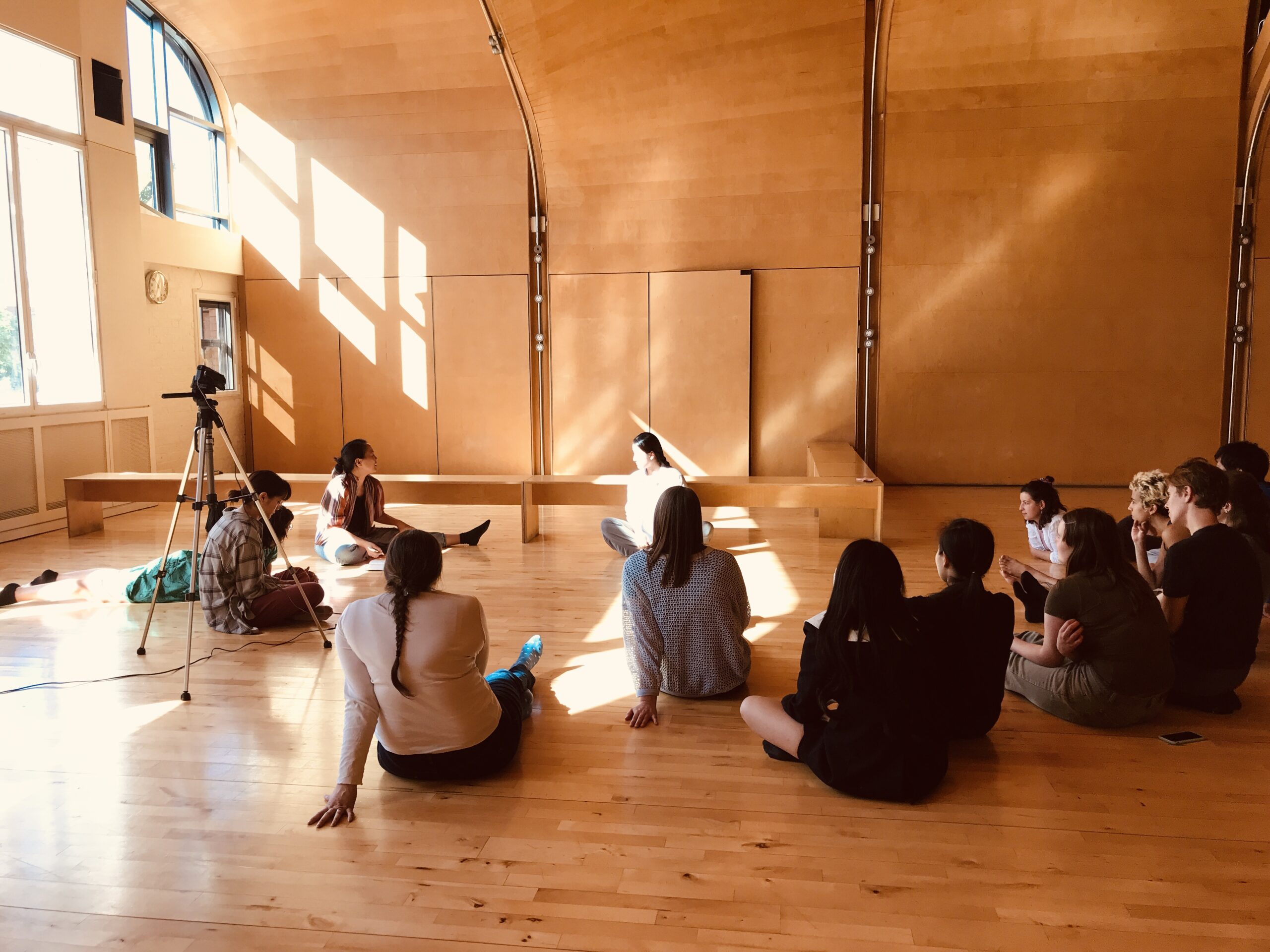
Since its inception in 2010, the MA/MFA Creative Practice: Dance Professional has offered a distinctive postgraduate qualification delivered across both a vocational setting at Trinity Laban Conservatoire of Music and Dance (which leads the programme) and a professional dance context through Laban’s partners, Independent Dance (ID) and Siobhan Davies Studios (SDS). This unique collaboration between academia and professional practice immerses practitioners in a community of artists that continues to thrive long after graduation.
What’s more, each year students work with different lead artists. The programme’s Investigative Practice module for instance is led by a curated selection of artists including Seke Chimutengwende, Florence Peake, Jo Fong, Annie Pui Ling Lok and more. This year, the module has been led by emilyn claid.
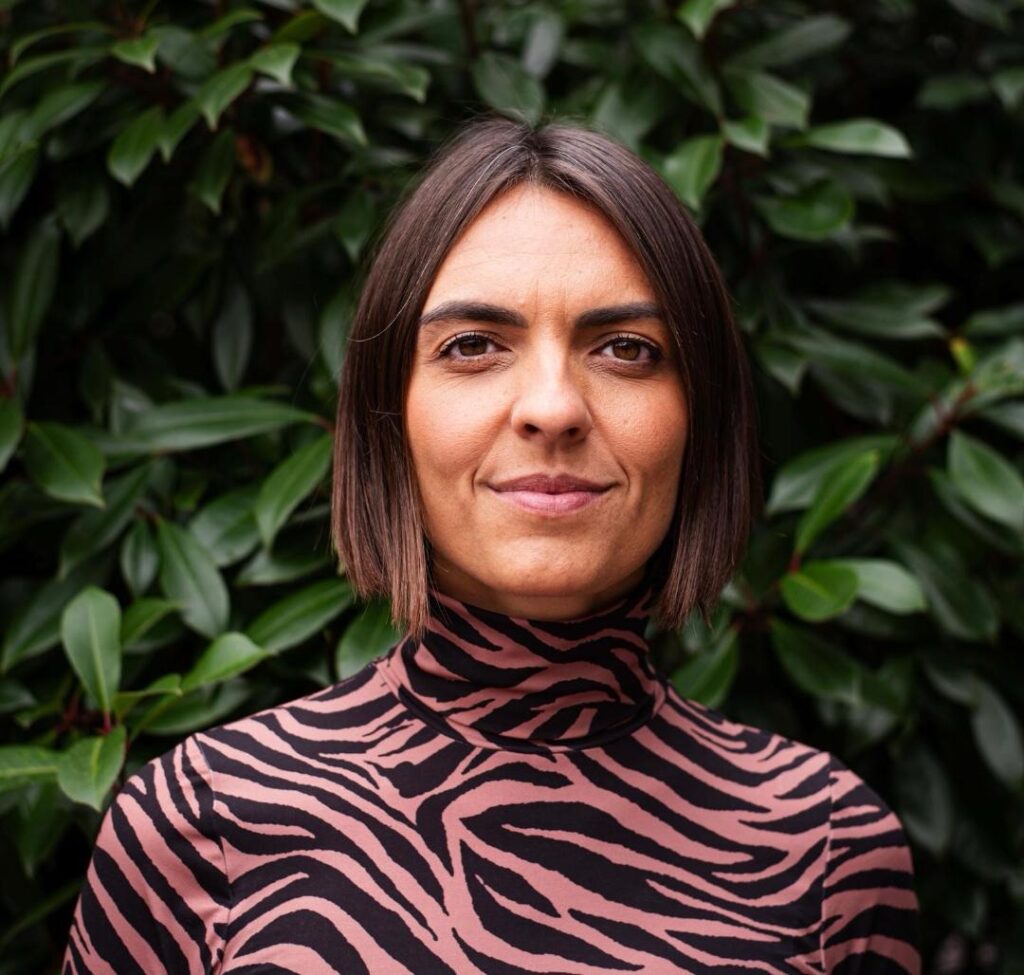
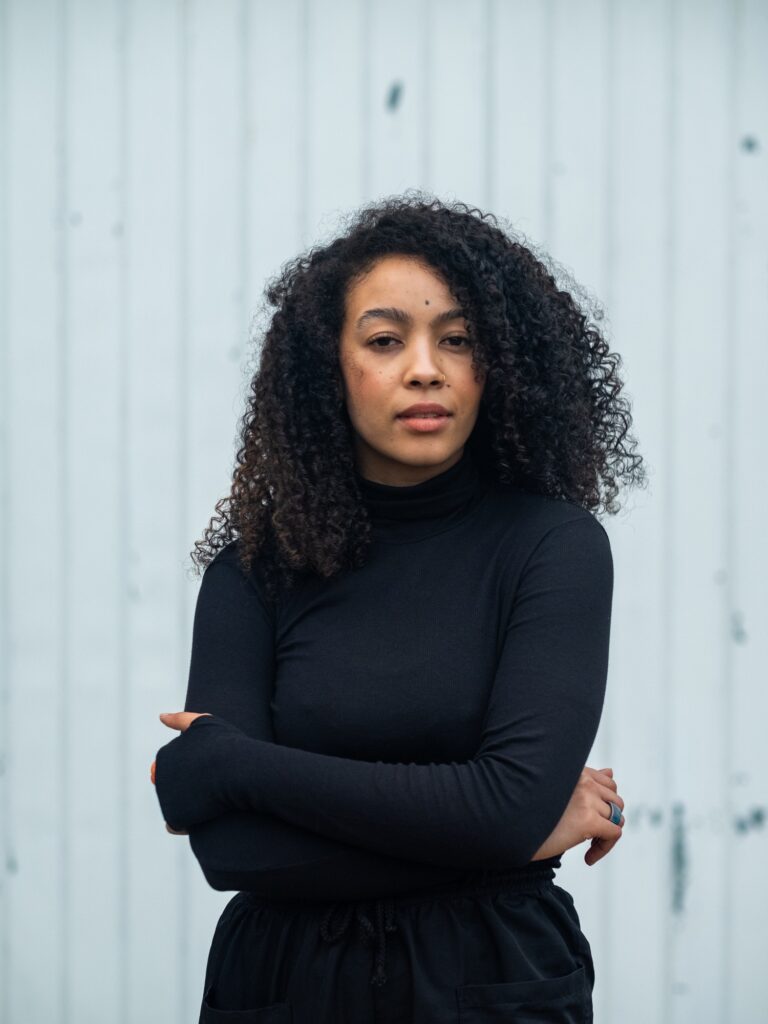
I caught up with 2022 MFA alumna Manuela Albrecht (MA) and 2021 MA alumna Francesca Matthys (FM). In conversation, Manuela and Francesca reflect on their motivations for beginning the course, how it has transformed their artistic practice, and the ways it continues to shape their careers today.
SR: Hello Manuela and Francesca. Could you tell us a little about yourself as an artist and your practice?
MA: I am a movement artist, as well as a performer, facilitator, researcher, and parent! I’m currently completing a PhD in Dance at Kingston University. My practice sits at the intersection of dance, theatre, embodied practices, and community, particularly using movement as a channel for arts activism.
FM: I am an interdisciplinary dance artist from South Africa. My practice is very much rooted in connections and disconnections, and acknowledging relationships to ancestral wisdom, particularly as someone who has had fragmented relationships to my cultural heritage. My practice is called Stepping in Situ, which seeks to find alternative and nuanced ways to draw from our ancestral knowledge in a way that can support us as holistic beings and in our artistic practices.
SR: Where were you in your practice when you embarked on the programme?
MA: In January 2020, I had just quit my part-time job to go full-time as a freelance artist. Then the pandemic hit. Having recently moved from Brazil, I was left utterly disoriented — I lost all my income and most of my friends, who returned home.
I thought, “Maybe I need to go back to studying?” I realised that an MA/MFA could help me figure out how to situate and articulate my practice within the UK context.
FM: I’d been doing a dance internship based on a farm, an amazing experience with a dance company called the Forgotten Angle Theatre Collaborative in South Africa. I had completed a BA in Dramatic Arts where I began to explore my movement practice through physical theatre, and after the internship I really wanted to continue pursuing movement as a core element of my practice.
SR: There are many courses like this in London. What drew you specifically to the programme?
MA: The partnership between Trinity Laban and ID was a big pull for me. I’d always been drawn to ID’s artistic community and its practice-based research projects.
What made this course special was the opportunity to be part of other people’s research. The course encouraged constant dialogue and exchange with fellow artists; during the course, I was involved in at least four different people’s projects, and I continue to collaborate with them today. Not many courses operate in this way, and it stops you from being precious about what you’re making. I learned so much from others that I could then apply to my own research.
There was also a practical element — I was living in Peckham at the time, so SDS was very easy to access.
FM: I felt it was a space for artists to really deepen their understanding of what it means to have a practice.
One of the great things about doing an MA/MFA that is connected to three large dance organisations is that it was really fundamental in allowing me to make networks with people that would support my career. Just being connected with such a diverse and international cohort of MA students was really beneficial because a lot of the individuals that I engaged with – I am still connected with through the industry.
SR: You both mentioned wanting to orient yourself within London. Could you share how the programme helped locate you as an international artist?
MA: Absolutely. I’m very grateful to this course, particularly the ID side of it, because it gave me the ability to start from the body.
My professional training was in physical theatre rather than dance, and the Dance Professional Pathway allowed me to explore my practice through movement as a bridge between these two mediums.
The intensive modules at ID helped me to dive inward — to question and interrogate my practice — before creating work in the world again. It was an intense and deeply transformative process.
FM: I think one of the initial things that I experienced during the application process was just the kindness from the staff who supported me. I can still remember her name, Alison, and how supported I felt as an international student at the time.
SR: Two modules unique to the Dance Professional Pathway at ID are Embodied Practice and Investigative Practice. Could you describe your experience of these?
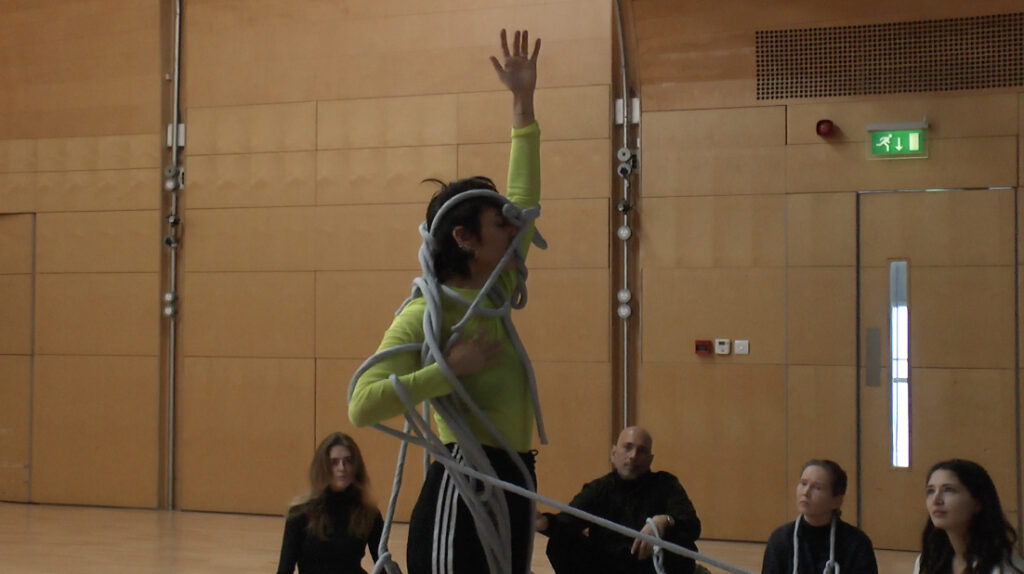
MA: The first module, Embodied Practice, led by ID and held at SDS, allowed me to fully immerse myself in somatic movement. It was led by Gaby Agis and Heni Hale, alongside several incredible guest artists and facilitators, including Thomas Kampe, Amy Voris and Sherwood Chen. A particularly impactful lecture by ‘Funmi Adewole Elliott introduced me to the concept of positionality and the empowerment of non-white and international artists.
It made me realise that for a long time I had been blending in — which was painful, like trying to fit a puzzle piece into the wrong slot.
For Investigative Practice, the module leader then was Wendy Houstoun, with guest artists such as Temitope Ajose and Matthew Harding. Matthew brought his background in hip-hop and community dance, while Temi shared her sounding practice.
During this module, I created a solo exploring the recycling process in the UK. Over the five-week duration, I kept all of my dry waste, then built a narrative by interacting and creating a costume from the rubbish. Investigative Practice felt much more outward-facing and expressive.
FM: These two modules really cemented the beginning of my practice or my understanding of how to allow my body to exist within a space of practice.
SR: What would a typical day on the course look like? How did you divide your time between Trinity Laban and ID?
MA: When I first started in September 2020, I was taking two modules at Trinity Laban, where I mainly used the dance studios and library for individual practice and research. In the second term, I moved to ID for the five-week intensive modules. We’d have a morning class, followed by self-directed practice in the afternoon.
There was a trolley full of books at ID, so we could read, write, and physically experiment within the same space. It was incredibly immersive.
FM: I spent a lot of time in the studio. I tried to be in the studio at least like three to four times a week where I would just move and explore. Sometimes I would give myself tasks. Sometimes I would just be in the studio with elements like music that connected to my cultural heritage that were sort of allowing me to continue staying within the themes and the research space.
SR: In terms of your final project, was it written or performance-based?
MA: At the end, you complete a ‘showcase’, but not a performance in the traditional sense.
My final project was a sharing of practice exploring how giving and receiving mycelial forms of support could reflect the complexities of belonging. My argument was that under capitalism, we often struggle to feel a sense of belonging because we lack stable networks of support. The physical sharing lasted around 15 minutes, followed by a reflective discussion.
SR: How has life unfolded post-graduation, and how did the programme prepare you for what you’re doing now?
MA: Although I graduated in 2022, it continues to be a source of empowerment. Considering the political tensions surrounding immigration today, I don’t think I would have had the confidence to be experimental and enter new creative spaces without it.
After the MA/MFA, I wanted to continue studying, so I went straight into a PhD. I was very fortunate to receive a studentship from Kingston University, where I’m exploring how dance and somatic practices can cultivate embodied ecological awareness through the logics of mycelium.
Alongside this, I’ve been leading classes — I teach Brazilian samba at The Place and facilitate Wednesday Moving, a community dance space in Hackney run by Olly Otley and Galit Criden. The MA gave me the tools to articulate my practice clearly — to say, “This is who I am, this is where I come from, and this is what I bring,” rather than trying to fit into existing structures.
My connection to ID’s artistic community remains strong. I recently shared my PhD practice at Siobhan Davies Studios, attended by many of my tutors and peers from the MA. I’m also planning to apply to lead a morning class at ID and to share more work at Crit Space.
FM: Post-graduation, the course has stayed with me and continues to offer me a kind of clarity. It enabled me to understand what I want to keep investigating as an artist.
SR: Finally, do you have any advice for those considering applying to the course?
MA: Trust the body. I know it isn’t always easy, but try to keep your practice joyful. The pace of London life doesn’t always allow space for everything, and sometimes there’s only so much the body can give or create. It’s okay to slow down, to breathe, and to be generous with yourself.
FM: For me, coming from South Africa and facing such geographic and financial hurdles to get here, I really felt the course (and the bursary support I received) allowed me to really get the most out of what I wanted from my practice and the resources I needed to help me get to where I am today.
If you are keen to critically reflect on your artistic practice, the MA/MFA Creative Practice: Dance Professional is currently accepting applications. To find out more about how to apply and details of the course, follow the link here.
Two £5000 Leverhulme Arts Scholarships are available via Trinity Laban with a deadline of 20th April 2026. ID offers four £500 bursaries for the next academic year specifically for students who have personal caring responsibilities and where these commitments to caring are proving to be prohibitive to them undertaking this course. This support can also be for students travelling outside of London or the UK as a contribution towards travel and accommodation. The deadline to apply for this bursary is 20th May 2026.