Words by Amelia Langas.
I planned on getting to the performance right when it began, but after a train delay at Penn Station, I arrived towards the end of my slotted entrance time, about fifty minutes into Sweat Variant’s three-hour durational piece my tongue is a blade. The night before, a friend had excitedly told me about the performance duo’s let slip, hold sway, presented in 2025 at the Whitney Museum of American Art, leaving me eager for what was in store. “I planned on only staying an hour, but ended up staying the whole time,” he said. “I was captivated.” After conquering the precursory three-hour trek, delays and all, from my Brooklyn apartment to Hudson, New York, I finally entered the Hudson Opera House where my tongue is a blade was making its U.S. premiere as part of PS21’s The Dark festival, a showcase of contemporary art performances and installations.
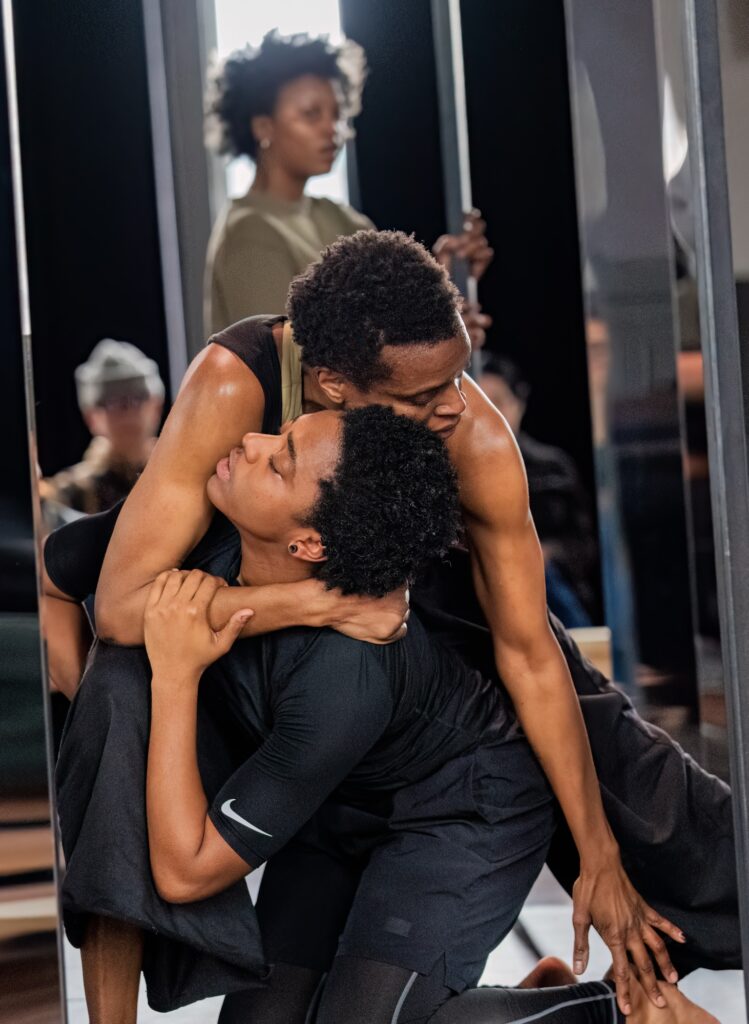
Choreographer, performer, and writer Okwui Okpokwasili and director, composer, and designer Peter Born comprise the artist duo known as Sweat Variant. Known for creating performances that sensitively blend dance, theater, and sculpture without ever confining themselves to a singular box, Sweat Variant previously presented my tongue is a blade in June 2025 at the Irish Museum of Modern Art in Dublin and at Art Basel Qatar. Over the course of those three hours in Hudson, four performers including Okpokwasili restrained, supported, nuzzled, and ricocheted off each other, ebbing and flowing between duets and solos exploring memory and attention.
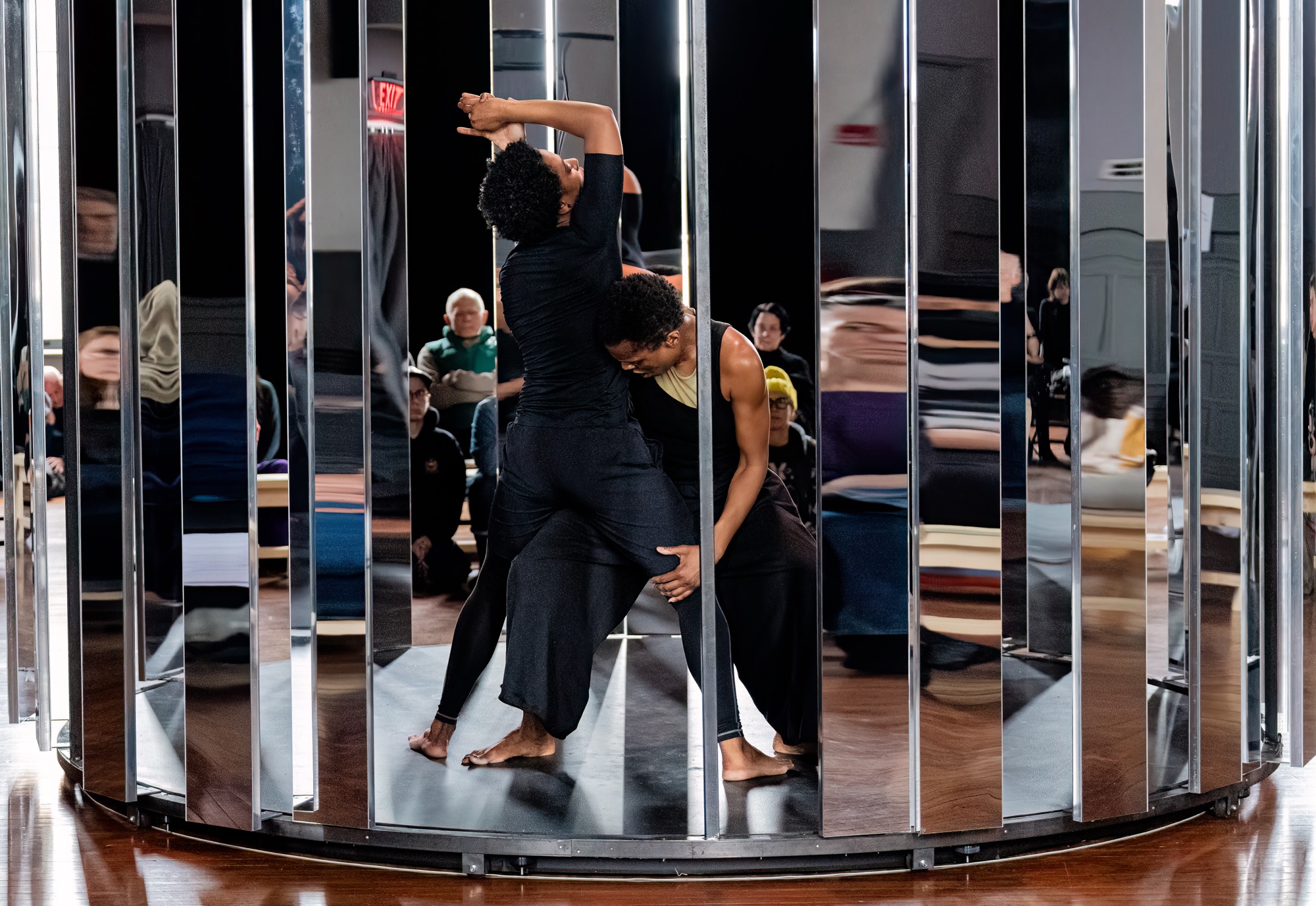
Although there was a proscenium stage in the opera house, it was eschewed for this performance. Instead, the performers contained their movements to a circular platform in the center of the room elevated an inch or so off the ground and the immediate space around it. But perhaps the most visually scintillating part of the environment was the perpetually rotating structure of intermittently spaced double-sided mirrors surrounding the platform, kept in motion by one or another of the performers. The structure literally glimmered, casting unchoreographed moments of light around the room, interrupting the dancers’ bodies as they moved within its confines and reflecting the audience’s own faces. I caught startling glimpses of myself in the mirrors as the structure spun.
This decided unification of audience and performer, a threshold crossed, evoked a shared intimacy: as the audience witnessed the performers, so too did the performers attend to the audience, at times even making direct eye contact. As audience members, we took part in this ritual of relation, doffing our shoes before entering the performance space and sitting on benches, chairs, and child-sized stools arranged around the mirror structure. Some also stood while others, myself included, opted to sit on the floor. You were never confined to a specific seat and could come and go as you pleased for the duration of the piece. Once I sat down though, I only moved to change seating positions, entranced by the urgency and sincerity of the dancers’ movements, how they fell into each other in duets and held the memory of other bodies in solos. Maybe I was also slightly hypnotised by the rotating mirrors. While there was a physical boundary of space between the performers and the audience, I felt pulled into their world as though following a path of centripetal force.
Okpokwasili’s movement and composition converged with Born’s sonic and set designs to create a ritual-like experience of collective effervescence—what sociologist Émile Durkheim called “a sort of electricity” generated when a group of individuals comes together to perform a religious ritual and that closeness “launches them to an extraordinary height of exaltation.” Through collaborative and individual movement languages rooted in relation to each other and the mirror space, Okpokwasili and fellow performers Bria Bacon, Kris Lee, and AJ Wilmore built a landscape of mutual support, recognition, and departing, tapping into the ephemerality of memory and relationships. As the performance came to a close, the dancers left the space one by one until only Wilmore remained. They gave the mirror structure one last running push, then exited. Gradually, the structure came to rest and I was left staring at myself in one of the mirrors.
Exiting the opera house, I felt as if coming out of a trance where I’d glimpsed a space beyond the corporeal and approaching the spiritual, a realm where the boundaries of both my person and my psyche had broken and conflated with those of everyone else in the room. I remembered something mysterious and ancient, awoken by that collective effervescence. My friend who had accompanied me to the performance remarked breathlessly, eyes wide, “They need a comedown room after that.” And I understood.