Words by Zara Joan Miller.
A woman in a pink dress laughs into a Ziploc bag then stuffs it under her arm, “for later”. Her name is Nazareth Panadero, she announces to the audience, enunciating each syllable: “Na-za-reth Pan-a-de-ro, and don’t forget it.”
Panadero is one of the original cast of Pina Bausch’s Sweet Mambo and a guest performer on this 10 night run at Sadler’s Wells. Originally performed in 2008, dancers periodically introduce themselves to the audience throughout Bausch’s penultimate piece, in which the ego takes centre stage. “My name is Naomi Britto,” says the first dancer on stage, “not Naay-omi, but Nye-omi, and don’t forget it.”
Dancers announce themselves indignantly to the audience throughout Sweet Mambo, using their real names. Identity, selfhood and the ego’s complex scaffolding, are the constant business of the eleven dancers on stage, as they disappear and reappear from a diaphanous white back-drop. Designed by Peter Pabst, these deceptively simple white drapes begin to move as unseen winds cause them to billow, at times briefly catching the self upon them in shadow form. The wind’s force accumulates and subsides throughout the piece just as the egos, untethered, areis thrown about the place.
A dancer pours a large bucket of water over herself. Often with Bausch, there is a sense of overpouring, of emotions unleashed. “I’m so angry I could kill someone” another dancer confesses, having previously entered the stage serenely playing a singing bowl. Props often function as punchlines. “I feel so empty you can’t imagine how empty I feel” a dancer announces, clutching an empty water-cooler bottle. Yet, under the laughter, there is a palpable sense of a self that has been provoked, and remains unsettled.
No one dances the mambo here. Instead a relentless back-and-forth is established between dancers. Physical and psychological tugs-of-war that, like a mambo, repeat and then break. The ego collapses, catches itself, falls again. A woman screams into a pillow. A man holds the length of a woman’s dress out to the side only to plant his face in its fabric again and again and again. To her delight.
“Repetition is not repetition,” Bausch said in 1985. “The same action makes you feel something completely different by the end. I repeat something and after three times, the person should react.’’ Bausch was the queen of transforming commonplace gestures into pageantry. “I see almost daily many people who are very tired and sad. And these feelings too are captured in our pieces,” said Bausch, who used to hide under tables in her parent’s restaurant, staying there for hours listening to “friendship, love, and quarrels.”
The ego is not the only thing at stake in Sweet Mambo. As with much of Bausch’s work, it is concerned with relationships and relationships between men and women in particular. It is a Sadler’s Wells tradition to programme Pina Bausch around Valentine’s Day, yet the timing this year seems particularly pertinent to the piece. A man applies lipstick as he makes eyes at a woman across the stage. He kisses a large white plate, looks at her seductively once more, then drops it onto a white pillow. “Don’t drop it!” she says, irritation in her voice. Later the same dancer chases another off stage flicking a cigarette lighter at her legs, all the disquieting things men and women do, to attract, to repel. In Sweet Mambo, we witness how flirtation can quickly take a sinister turn. Bausch shows us both the action and its aftermath – how the body holds trauma, how it learns to move.
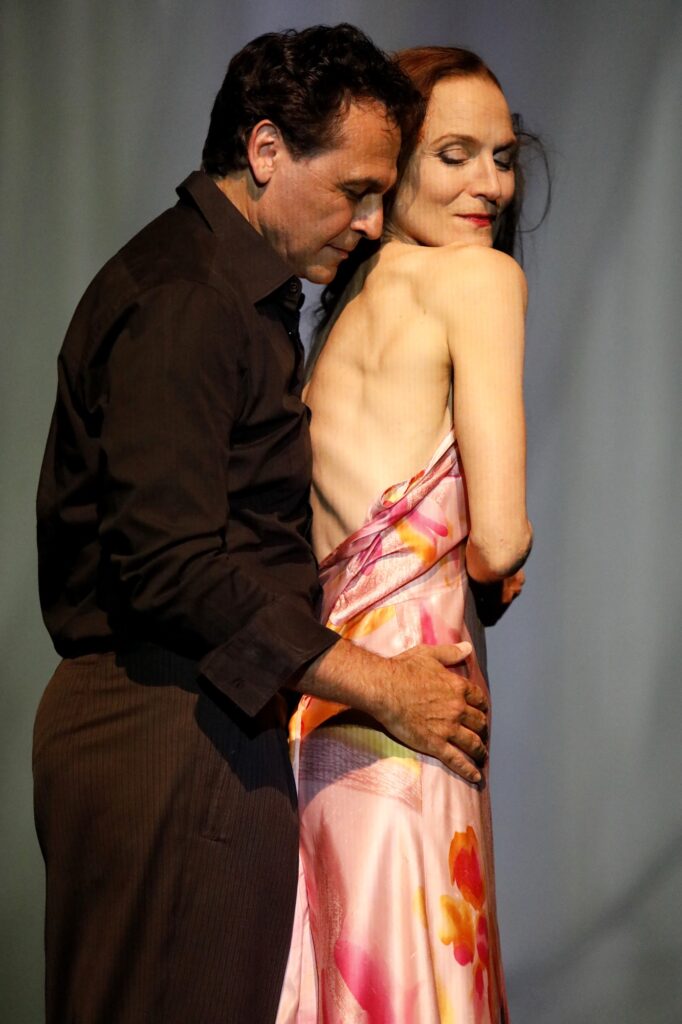
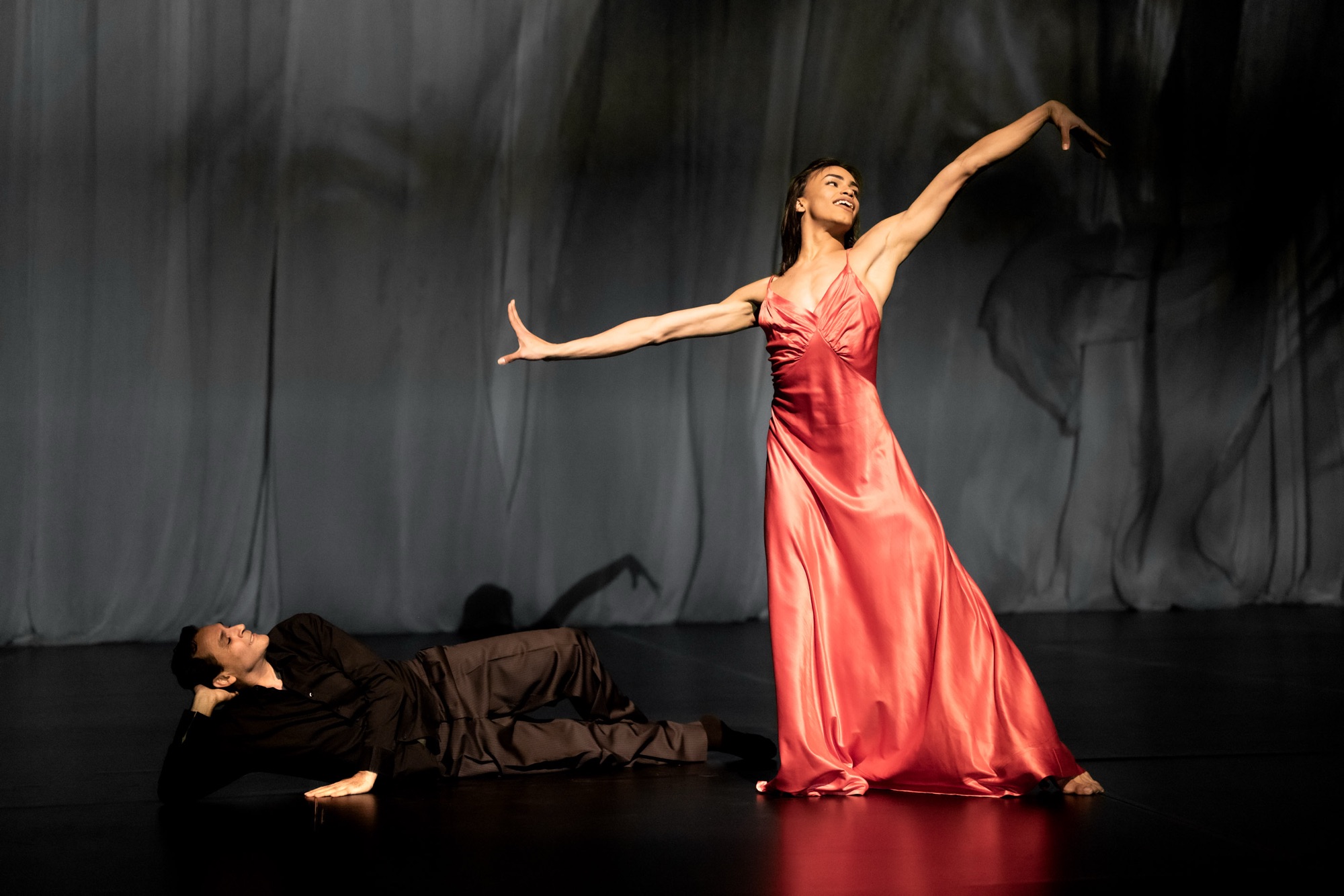
Dressed uniformly in black shirts and trousers, the men in Sweet Mambo often function like interfering stagehands, moving the women around like furniture. Originally written to be performed by an all-female cast (Bausch added three male dancers as the work developed), the women do almost all the talking in Sweet Mambo. The female dancers all have solos and wear microphones, introducing themselves by their real names. Only one male introduces himself to the audience, towards the end, then recounts a memory of time served in the army. He is, notably, wearing a dress.
Bausch often asked dancers to bring in personal anecdotes to the stage and, while her pieces often poked holes at the fourth wall, in Sweet Mambo it becomes more porous than ever. A dancer kneels at the edge of the stage beckoning a man from the audience to unzip her dress. Another dancer climbs down to the second row inviting an audience member to whisper his problems in her ear, then offers to scream for him. She returns to the stage, and screams. Dancers even talk amongst themselves on stage, recounting memories from being on tour. Blurring the boundary between life on- and off-stage, these moments are dropped like oil into the inner mechanism of Sweet Mambo: concerned, as it is, with the way the self is performed.
Emotions are held to the light, revealing skeletal forms, all their fractures. A woman demands a man hold the end of her hair in one hand, her dress in the other, so she may run like a horse, tethered to his pole. But he runs too, and as they circle the stage together we are reminded of the complicated texture of pain – how it is often self-inflicted, interdependent, begging to be held.
Another dancer recounts a funny memory about a man in Los Angeles trying desperately to talk to her. Later, she finds herself desperately trying to talk to a man. Tables turn. Another mirror: we are met with versions of a self once rejected. While there is no clear narrative in Sweet Mambo, there is the sense of personal trauma and the coping mechanisms the self constructs in order to deal with trauma. “a woman had a terrible thing happen to her” Nazareth tells the audience, as two men hold her under each arm, “and she said THANK GOD I’m already mad!”. She laughs and laughs and laughs, this time there is no Ziploc bag.
There is much laughter in Sweet Mambo, yet, for all its mockery it keeps pointing towards a universal condition: the crisis of being human in an all too human world. The week Sweet Mambo came to London I was reading Schizophrene, Bhanu Kapil’s fragmentary account of immigration and trauma. Written as a response to witnessing the aftermath of Partition in India, Kapil’s book is a world apart from the relatively privileged identity crises that play out on stage in Sweet Mambo.
Yet, the dilemma of selfhood, present in both, speaks to a spectrum of experience. A dancer gives the audience advice on how to make it look like you’re always smiling at a party – the stakes, here, are relatively low, yet emotions in Sweet Mambo are often left to cartwheel to dizzying proportions. We are reminded of the extremes of the mind, of the fragility of it all, however privileged one’s position may be. “vertigo is a symptom of profound attraction. An excess of desire” writes Kapil. The dancers in Sweet Mambo dance like their lives depend on it, and they do. “Life is like riding a bicycle” Nazareth Panadero repeats to the audience, “you either ride or you fall”.
As in all of Bausch’s work, in Sweet Mambo, we see ourselves repeated. All our frantic efforts, our little failures, and one unending question: How do you respond to a world that can seem hostile to your efforts?
As I’m writing, it’s the day after Valentine’s now. It’s been raining all week. There’s a fake rose in the gutter. It will outlive the real ones. Sometimes the rain can feel personal, when you forget your umbrella, when you get caught out. My toddler doesn’t care, he will get happily drenched. When did getting caught in the rain become a problem? He hit me in the head with a toy train this morning. He was playing. I don’t know how to teach him about pain. About repetition, about reading the world and learning to react, responsibly. There is a choice. There is a buffet of choice. As with much of Bausch’s work, Sweet Mambo reminds us of this. Yet it also reminds us of a stunted truth – as much as we try, we cannot always be the masters of our emotions.
“Julie, Julie, Julie”, a voice calls from off stage. Julie Shanahan runs towards the voice, each time she is pulled back by two men. “Let me go”, she screams, more desperately each time. Lightning is projected onto the white curtains in this scene, we hear a thunderstorm. It’s almost naff, almost a Celine Dion video, but Julie’s relentless plea to escape slowly burrows in and all of a sudden I find myself brought to tears. It’s the Bauschian trick: “repeat something and after three times, the person should react”. But Bausch is not trying to trick us. There is no manipulation here, rather a reflection – the self caught in a car window, a glimmering recognition, something unearthed.
Julie, another name. I give my child a name so he can be in the world. I am legally obliged to. He has started to centre himself around this name, a pivot for his sense of self. If Sweet Mambo is about the construct of the self, and how this self is performed in relation to others, we can’t help get caught in the dance. But what makes the mambo sweet? I want to say laughter. Laughter as a coping mechanism, the real nectar. Not a saccharine thing, but a way of lightening the load. A train to the head. A rose in the gutter. Getting caught in the rain. The small theatre of our everyday lives. We tie ourselves in knots. We inflict pain without meaning to. Sometimes we mean it. Do we ever grow out of it? And do we ever grow out of the desire to stand up and announce ourselves to the world?
By Zara Joan Miller, and don’t forget it.
Header image by Oliver Look.