Words by Francesca Matthys.
Nandita Shankardass’s Roots to Rise never fails to warm my heart, entice me and remind me of the importance of representation of stories from the Global South on UK stages.
I have had the pleasure of following the development journey of Roots to Rise from its garden sharing at Omved in 2024, and now having witnessed its latest version at Greenwich Docklands International Festival last summer after touring across the UK supported by Without Walls.
Roots to Rise has no doubt continued to blossom into a charming outdoor dance work that holds inherited memories, premising South Asian identities, womanhood and connection to mother earth.
Early in the work we hear the words “What was it like back then? Come I’ll show you” followed by the same voice then questioning and affirming There is a weight that holds me back…is it mine to carry? Ours to transform into light…it is time to heal.”
It is wonderful to see how this work, that was already rich with meaning when I first saw it, has further been embedded with context and story. It’s an embodied portrayal of multiple generations of women in dialogue as we watch the performers observe individual to shared pathways in the space.
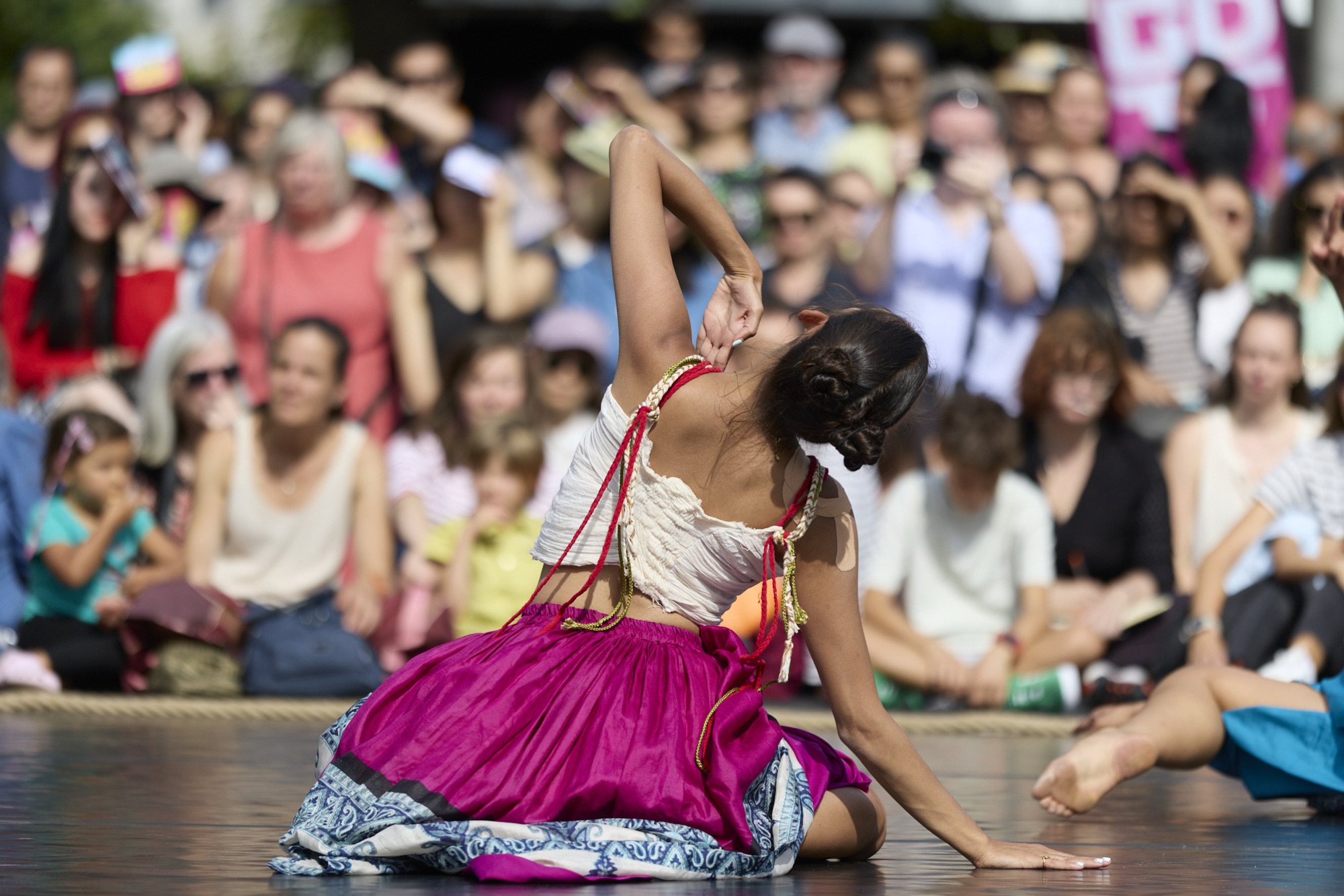
As a handpainted circular artwork is revealed to us, illustrating this interconnection to earth and lineage through colourful flowers, fruits and a long dark braid, this rich world is illuminated for us. This is complemented by the performers crafting the space around them, through expressive spines, graceful eyes and potent hand gestures.
As seen in its first iteration, we see the influence of classical Indian dance techniques such as Bharatanatyam. Signified by its fixed torso and gestural hands, we see the trio of dancers embody generations of strength in their backs.
Through this amalgamation of classical Indian and contemporary dance, Shankardass’s choreography is mesmerising to watch, creating ripples and wave-like movements indicative of the organic qualities found in nature.
Upon watching this version of the work, I did miss the winding green pathways of Omved where it was first performed. This spatial configuration presented on a more conventional outdoor stage did however offer a focused lens on the movement vocabulary that allows for a strong appreciation for its artistry.
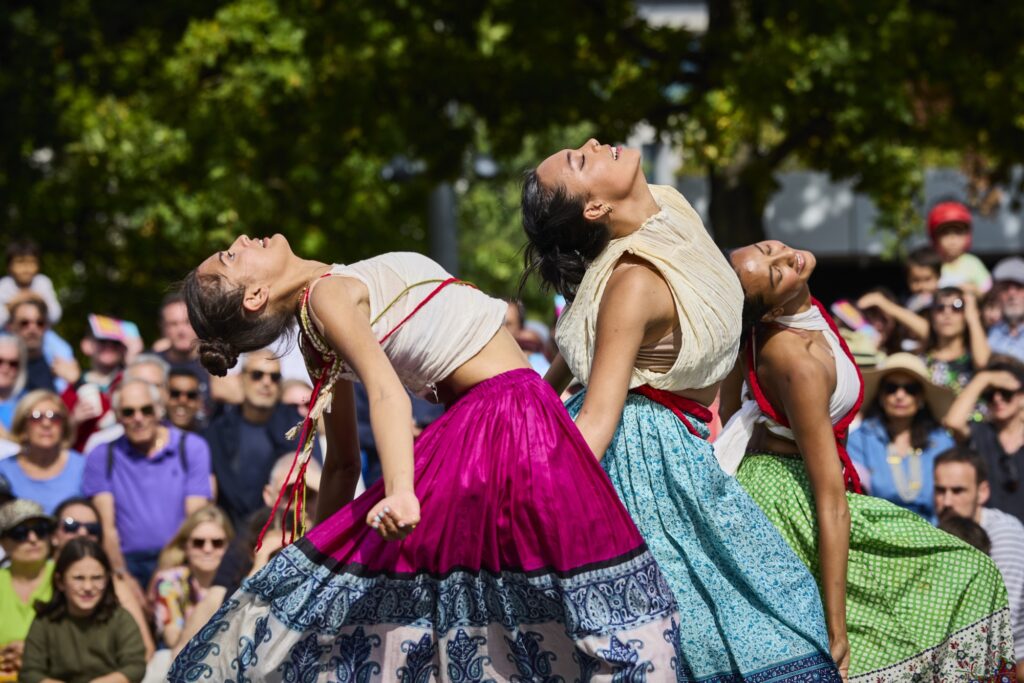
The work’s dynamic score by a collection of artists Amrit Kaur, Alam Khan, Arjun K.Verma, Del Sol Quartet, Flux, Nilan Chaudhuri, Ojas Adhiya, Sabiyha and additional music by Shammi Pithia, drives this quest the performers embark on, one of struggle that is concerned with the self and community, that fluidly morphs into togetherness through a reciprocal row of hair oiling. An intimate exchange of intergenerational connection and affection. This is probably one of my favourite moments of the work, one that I carry with me as I hold my own maternal connections dear. We see the performers move in and out of states as if they take on the roles of their mothers and grandmothers who have fought for their liberation, but also themselves as young girls held by this maternal line.
Halfway through the work, the spirally movements of Tulani Kayani- Skeef become infectious as the trio begins to process through spiralling, mirroring the vibrant artwork. Perhaps as a way to transmute and alchemise their experiences and the ones they have inherited, their colourful skirts and red strings attached to their torsos twirling along with them in the wind.
Red thread in various South Asian contexts is rich with meaning and these striking costume details could represent the physical manifestation of strength through womanhood or a sense of auspiciousness that is present with this connection to ancestral stories.
Once again the work evokes images of ancient female healers that harness change and transformation through the element of fire and circular pathways. The final expression is one of power dynamics, control and anguish, portraying the performers in contrasting roles and characters that may reflect their ancestral pasts.
Rising into joy, and defiance, this dance is wholesomely amplified as the audience is invited to the stage in a celebratory maypole dance, sharing that triumph and transformation are joint actions.
Roots to Rise is incredibly heartwarming with expressive nuance from delightful performers Tulani Kayani-Skeef, Karishma Young and Aishani Ghosh. I certainly hope this work has an extended life this summer as more audiences deserve a bit of hopefulness through dance.
Roots to Rise will tour again this summer within the UK, visit here for more information.