Words by Isabela Palancean.
Defining free movement can be hard, but we all have certain images associated with it. A swimmer floating in the sun-dazzled sea. A raver whose body seems congruent with the space surrounding it.
Both of these images depict a blurring of boundaries between the external and the internal, where freedom is not necessarily manifested as choice, but rather as a dissolution between mind and matter, intention and impulse.
In a post-enlightenment world structured by rationality, however, can one still move freely?
Premiered at Sadler’s Wells Breaking Convention Back to the Lab 2026, this is what Anna Watanabe’s Magokoro: Before Thought sought to explore, hinting at the possibility where opposites may coexist, and where dialectical tensions may lead to transformation.
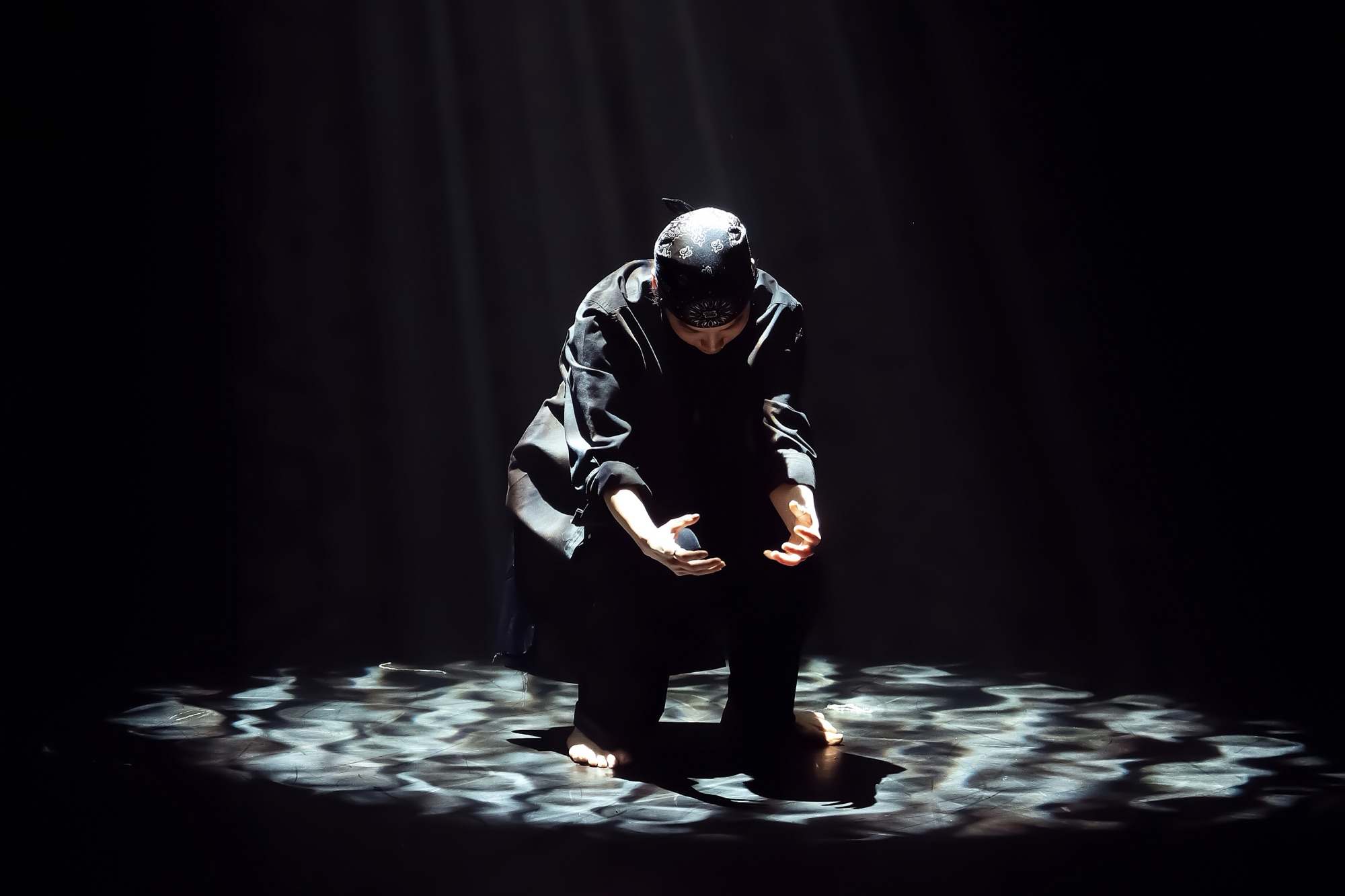
Beginning in silence, Watanabe introduced the character of the ‘conscious dancer’ through forced, heavily measured movements. The stage shone a single spotlight on Watanabe, as she performed a series of stiff articulations, always returning to the same gestures: hands holding her head, a folded, anguished torso.
It reminded me of a quote by the Italian philosopher Thomas Ligotti:
“This is the tragedy: consciousness has forced us into the paradoxical position of striving to be unself-conscious of what we are – hunks of spoiling flesh on disintegrating bones.”
Watanabe’s initial struggle was, however, disrupted by the appearance of a second dancer, performed by Isla Sutherland.
Fluid phrasing, weightless shifts and momentum indicated that this co-dancer signified the conscious dancer’s anti-thesis. Via moments of interruption, the unconscious/subconscious dancer pierced through the rigidity of its counterpart, inviting a dialogue based on negotiation and improv motifs.
As the two dancers’ dialogue developed, the ‘conscious’ dancer’s movement gradually became more joyful and intuitive, as if absorbing the energy of their partner.
In contrast to the dancer’s initial, mostly static execution, the accelerating rhythm in the second half of the performance indicated the return of a certain vitality – a drive to let go and to surrender the burden of Ligotti’s ‘self-consciousness’. Shifting from white noise toward a hypnotic, balearic beat, the musical score carried this progression through.
When asked by the director of this year’s Breaking Convention Festival, Jonzi D, to share the first word that came to mind when watching the performance, words such as ‘reaction, exploration, nature, saving and liberating’ rang out from the auditorium. Mine was poetic.
What was it about Magokoro, that prompted this particular response?
Interestingly, the word ‘poetic’ derives from the Greek poiesis, meaning to create, often referred to as the process where something new comes into being through revelation or uncovering hidden truths.
The concept was revisited by Heidegger, placing particular emphasis on its physical aspect – or its ‘physis’ – as seen through the emergence of a butterfly from a cocoon, the blooming of the blossom, the plummeting of a waterfall when the snow begins to melt.
This Heideggerian current of ‘becoming’ was felt throughout the performance as the conflicting forces of the conscious and subconscious dancers encountered each other.
If the conscious dancer’s movement was initially defined by staccato and a sheer lack of transitions, the subconscious dancer’s, by contrast, embodied seamlessness. A quality that eventually draws the conscious dancer’s in, facilitating its shift into a new state of being.
While the piece was mostly focused on the development of the conscious dancer through the integration of its subconscious, it left room to explore the inverse question: What might occur if the subconscious was free to run without any guardrails in place, what would the effect of a complete absence of self-criticism be? Would chaos then simply take over?
Anna Watanabe’s Magokoro is a thoughtful, deeply felt work which tests the depths of the human psyche, without the gratification of any simple answer.