Words by Sarah Lapinsky.
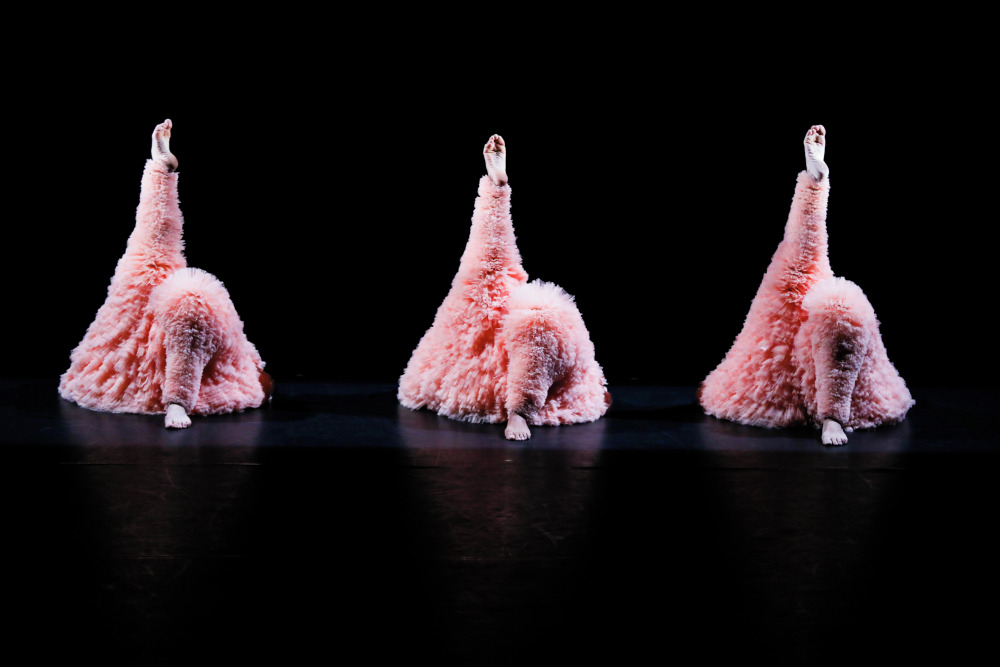
Out of darkness, an illuminated tutu spins around like a ghostly music box, setting the stage for six bountifully bouncing tutus, frantic fuzzy fruit heads, spicy ballroom partnering, comedic rhythmic gymnastics, elegant acrobatics and a lot of jokes throughout. How does that sound for a ballet?
Philippe Lafeuille, artistic director of Chicos Mambo, presents ballet through flamboyant, lovingly mocking vignettes in Tutu, the “gender norm-defying dance extravaganza,” and an extravaganza it is. The cast of six male-presenting performers plus a female-presenting performer dressed in all black, play through various scenarios of ballet and wider dance styles with grace, poise and a lot of fun.
Classical ballet lovers will have their moments to enjoy pointe work and variations from Swan Lake and Sleeping Beauty, but will see it performed by a topless male in a tiny tutu or glamorous crown. The technical virtuosity cannot be overlooked as the strength and grace extend through the movements with interjections of comedic situations, like when your partner doesn’t quite know the steps or when you realise just how much pointe shoes actually hurt. In a later section, you’ll see gravity-defying lifts that trick the eye as performers are lifted by a team wearing all black in the shadows.
You may have seen a snippet of their take on the “Danse des petits cygnes” while scrolling on Instagram. In that section, four of the performers don white, feathery costumes with bright orange bills and big fluffy tails to perform a silly, goofy rendition of the famous Swan Lake Pas de Quatre. Waddling, prancing and disco-ing their way through, they touch upon ideas of pop culture, shimmies and b-boying, with a subtle reference to the performativity of the male gender. These vignettes centering on ballet offer in-jokes to the avid dance-goers and those in the performing community, though others will be drawn to the campy caricatures and infectious energy.
Referencing Strictly Come Dancing, Dirty Dancing and the Argentine Tango, the performers explore sexuality within the work (still family-friendly) along with different gender roles and expectations that go along with it. Modern Dance was used in multiple sections and facilitated funny commentary on sweat and the genre of movement itself. I particularly found the pastiche of Pina Bausch interesting as Tanztheater Wuppertal performed Sweet Mambo just across town. As this company paraded the stage in long wigs and ball gowns, I noticed a distinct resistance in myself to see that highly impactful work made fun of. However, the little boy just two rows in front of me seemingly couldn’t get enough of their pop-culture references as he howled with laughter throughout.
Overall, the performance was highly enjoyable, but I left with a sense that there was a question unanswered or perhaps even unposed: Why an all-male-presenting cast? Throughout, I wondered, would this be funny if they were female-presenting performers? And if the answer is no, what could that mean? With respect to the vision of this cast and direction, there were a few moments that particularly stood out to me regarding this question. Five performers created a U-shape around one in the middle, asking questions that sounded all too familiar to male-presenting dancers, like “Do you wear a thong when you dance?” “Are you gay?” and others that displayed a vulnerability of masculinity within an art form seen as majority-female. Another instance I found powerful was when a performer wore a rugby headpiece with one of the tiny tutus and performed a cross between a ballet and a Haka. This drew my attention to the binary of expectations that males can experience and the difficulty we can see in accepting that people can be both.
It’s a difficult question to ask, especially within a family-friendly piece as that presents its own considerations, but what does it mean to perform gender? What does it mean to defy the norms of gender? Tutu offers no easy answers, but it certainly sparks reflection. And, crucially, it proves that questioning and subverting these norms can still be fun, funny and deeply enjoyable.
In the end, Tutu is a delightful and multifaceted experience. An expertly performed dance show that humorously plays with ballet and conventions with love and admiration. It leaves the audience laughing, thinking and perhaps even questioning what it means to perform, to present and to be.