
Words by Stephanie Burrell.
Manon Servage’s Letters of Silence, created with collaborator and dancer Zach Parkin, continues Servage’s choreographic inquiry into absence, rupture and the body’s capacity to hold what cannot be spoken. Where A Regarder les Étoiles, previously presented as part of Sofar Sound, meditated on death, grief and our relationship to mortality, Letters of Silence turns its attention toward relational fracture and the silences that accumulate between people.
Developed through an accelerated two-day process and performed almost immediately thereafter, the work embeds urgency into its structure. This urgency is not narrative but corporeal: a visible insistence to communicate, coursing through force, momentum and life-energy in the dancers’ bodies. The piece was presented as part of Sofar Sound London, produced by Laurie Casie.
The duet opens with distance. Servage and Parkin occupy opposite ends of the room, misaligned from the outset. Silence operates here not as emptiness, but as pressure. Early in the creative process, a typewriter-like push and pull informed the choreographic thinking — a repeated striking and retracting, an attempt to articulate before language arrives. Though this action does not remain overt, its logic permeates the work’s physical grammar.
As the dancers approach, contact is marked by mechanical clarity and specificity. Movement is impulsed through orientation: precise angles of arm, wrist and fingers become activation points for the other body.
A wrist meets a calf; a bent elbow redirects weight. Touch functions less as invitation and more as instruction. These exacting exchanges repeatedly collapse into simultaneous descents, palm, wrist and forearm folding cleanly into the floor as the dancers straddle standing and pack themselves downward.
The repetition suggests attempts to articulate the same message through different routes, still unable to allow symbiotic resonance.
Performed in front of the altar at St James’ Church, the work’s relationship to site echoes A Regarder les Étoiles, where sacred space held grief with reverence. Here, architecture heightens restraint. Tom Van Wee’s score layers industrial electronic textures with echoing reverberations that feel embodied, like spinal articulation — never uniform, always rippling — before softening into orchestral passages that briefly suspend tension. Sound and silence operate in tandem, shaping breath, timing and effort.
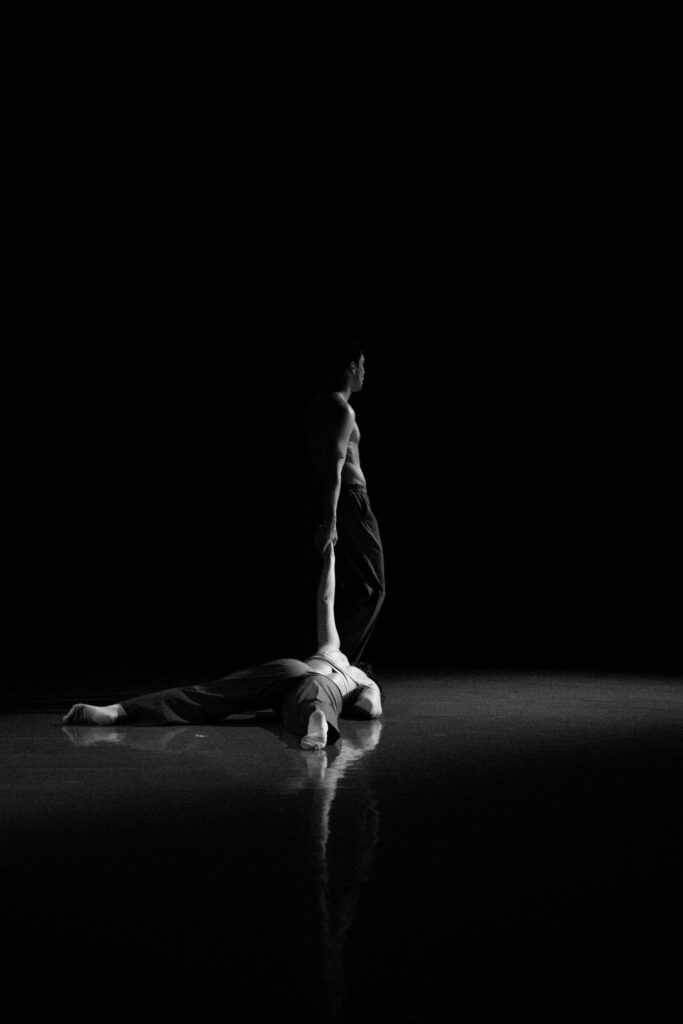
Parkin’s weighted body moves through a Cunningham-inflected spinal bounce stripped of buoyancy.
Servage draws him upward from the inner armpit as both spines twist away from one another, forming a counterbalance that exposes the mechanics of support while withholding emotional alignment. Parkin leans outward, outer leg extending into space as Servage opens the chest away from this exposure. The moment holds tension without resolution. Parkin withdraws from the offering, pulling himself back into a high développé that arcs behind Servage’s head — a contained and decisive action that reflects the work’s compressed development, where choices are made quickly and held with precision, mirroring the restraint and selectivity that silence demands.Gestures of reaching remain unresolved. Servage offers a hand that is ignored. Later, Parkin reaches for Servage’s shoulder while facing the audience, Servage turned away. The contact sends visible reverberations through Servage’s body — tension and tremor travelling along an extended arm — reinforcing silence as a relational condition rather than a pause.
Letters of Silence is shaped by speed, site and displacement. Developed through an accelerated process and performed in two cities in quick succession, it resists resolution. In dialogue with A Regarder les Étoiles, where grief was held openly and space was offered for mourning, this work attends to what follows: the quieter aftermath of loss, where communication fractures and meaning remains suspended.
Silence here is not empty, but persistent and embodied — carried in precision, restraint and the repeated urgency to speak through the body when words no longer arrive.