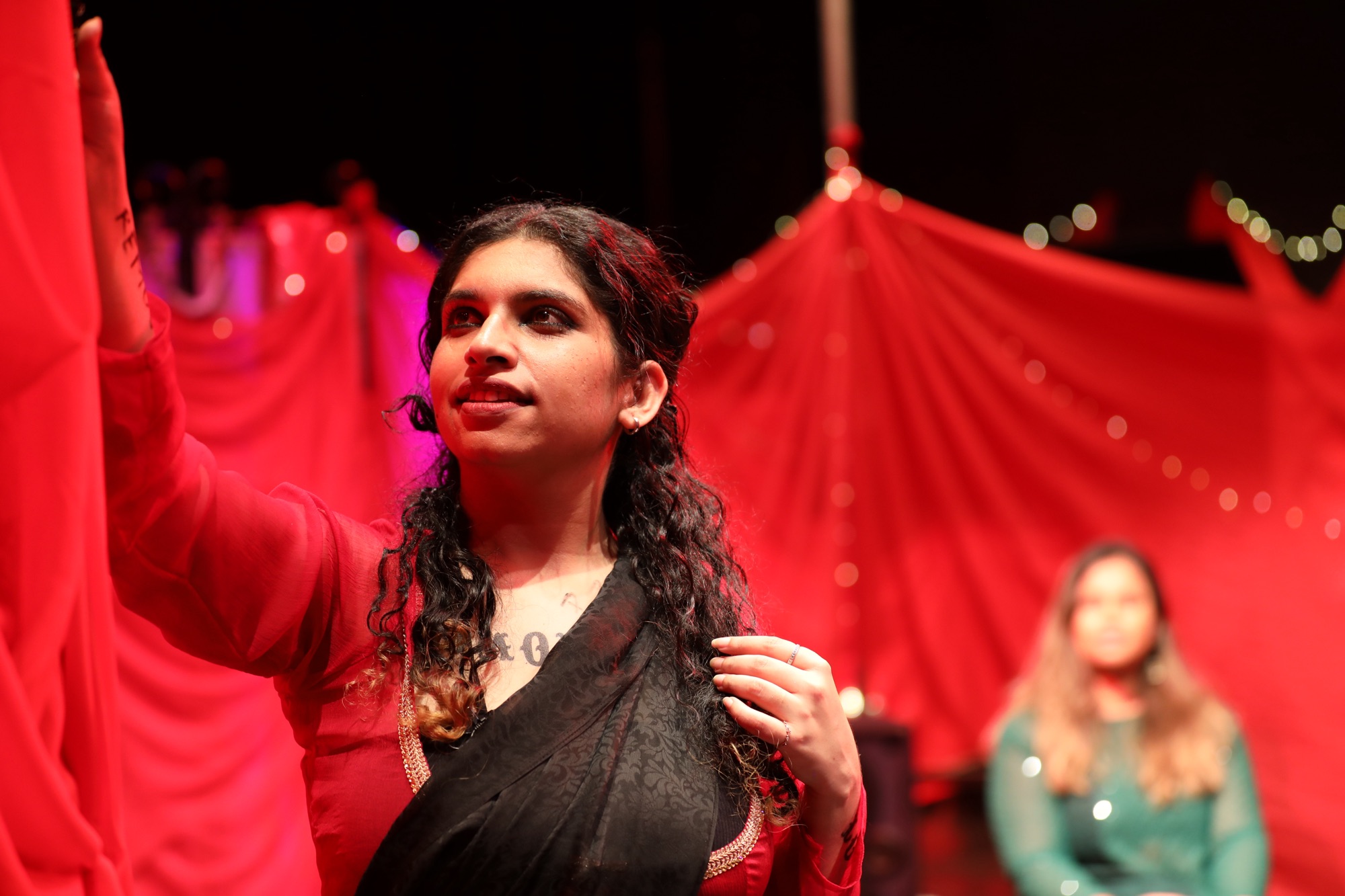
This month, Himadri Madan presents their eclectic new work The Gaze – you, me, us, and them. Trained in Bharatanatyam, Kathak, and Bollywood, The Gaze – you, me, us, and them blends movement, theatre, interactive exhibition, installation, and live music to examine the experience of women under the ever-watchful and weighty eye of society.
We caught up with Himadri to find out more.
Q: Can you tell us about yourself?
My name is Himadri Madan and I am a choreographer and dance artist with training in Kathak and Bharatanatyam, currently based in Edinburgh.
I moved from India to UK to pursue MFA in choreography at Trinity Laban Conservatoire of Music and Dance.
My work often centres socio-political themes while exploring Indian classical dance vocabulary through a post-modern contemporary lens.
Q: Can you tell us about your work The Gaze – you, me, us and them?
A: The Gaze – you, me, us, and them is a fly-on-the-wall immersive multi-media experience. It delves into my experience of being in a female body and shared with the audience through a character named Draupadi. While the name of the character comes from Indian epic Mahabharat, this is not a retelling of Mahabharat, but a story of a woman who has been impacted by all the stories, messaging from the media and the society’s scrutiny on her.
Q: What made you take inspiration from Draupadi by Mahasweta Devi and why?
A: I came across Mahasweta Devi’s Draupadi while researching for another project. It is a retelling of the story from Mahabharata set in a contemporary context. In the epics, Draupadi is saved from assault, but in this version she isn’t. Instead, she walks in front of her abusers, forcing them to confront what they’ve done and refusing to cover herself, which leaves them even more afraid.
That story began my exploration of how shame is weaponised, shame about our choices, our bodies, and our identities. It also deeply influenced the live performance element of the show, where I look at how our position in the world shapes the way we experience it.
Mahashweta Devi’s Draupadi is also a story of an indigenous woman in India and since I don’t have the lived experience of that community, I explore the themes from the text with being very careful that I don’t appropriate the experiences of a community that is not my lived experience.
Q: As an Indian woman and classical dancer, how do you convey female gaze and violence against women through a dance form like Bharatanatyam?
A: Indian classical dance is deeply rooted in storytelling. These stories often reflect the society and politics of the time they were created in. Drawing from that I use Kathak vocabulary in The Gaze, to tell the story of Draupadi, who is a dance artist preparing for a performance.
In the first half of the performance the audience is invited to walk through Draupadi’s space set as an installation where you can interact with every element that has left an impact on Draupadi’s experience of being in a female body.
In the second half, Draupadi is seen rehearsing with her colleague, played by Ankna Arockiam. And together they discuss the politics of the stories from their repertoire, reflecting on what kind of stories have they been telling through their forms and further reflecting on what kind of stories they wish to tell.
The performance brings contemporary pedestrian movement and Kathak vocabulary together to share these stories with the audience.
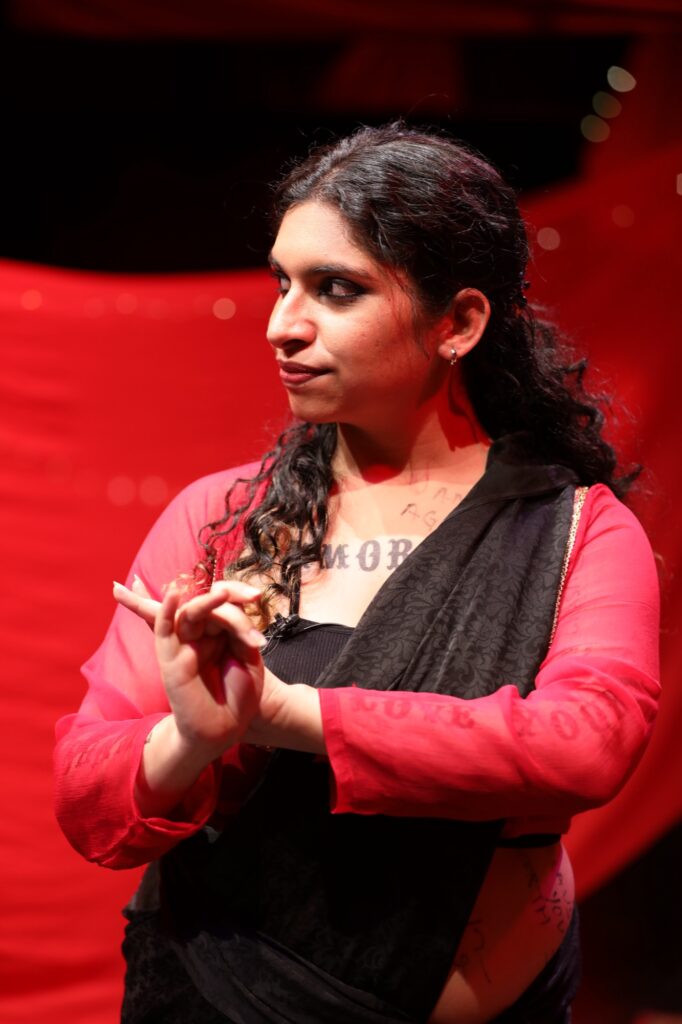
Q: How can dancing be a form of resistance, in your opinion?
A: I believe dancing can offer different ways of resistance. For me, being able to share a story that comes from such a personal place, one I wouldn’t have felt comfortable sharing even a few years ago, already feels like an act of resistance. I hope it doesn’t stop with me. I hope the audience and I can share a moment of recognising how we’ve all felt society’s gaze on us, and maybe even feel a sense of togetherness through that experience.
Beyond this performance, I’ve also been thinking a lot about joy as a form of resistance. I want to tell more stories from my experience as a marginalised voice, not only through narratives of pain, but also by making space for the joy that exists in our lives.
Lastly, I sometimes feel that simply taking up space as a minority can be an act of resistance in itself. To be in a room and perform my heart out without constantly thinking about how I am or will be perceived is something I truly aspire to.
Q: What’s next for you?
A: Along with a being a an independent choreographer, I also work as a core team member of Theiya Arts, a south Asian arts organisation in Edinburgh. We will be showcasing a dance film ‘Vertigo’ in collaboration with Dr Anindya Raychaudhuri from St. Andrew University in April.
Runs on 28 February at Capital Theatres, Edinburgh. Book here.