
Words by Francesca Matthys.
The word ‘improvisation’ finds its origins in the Latin word ‘improvisus’ which refers to the unforeseen, the unanticipated and unpredicted. Improvisation in many forms is rapidly spreading through dance practice around the globe, with Instagram and TikTok feeds saturated with moments of improvised dance. Instant composition. Though to perform the unknown live in front of a familiar and perhaps unfamiliar audience, in a very intimate venue in the middle of South London, is quite a marvel.
Four acts and five performers embarked on this feat for Mind The Gap’s 10th edition. A night of improvised performances, spontaneous happenings and art that, although captured through film and photography, was a magnificently fleeting experience of presence and play.
Alongside presence, the audience were met with presents through an olds-skool game of pass-the-parcel that continued throughout the acts, sparking our inner child.
Each performer found their way to that particular moment in time, through their own paths yet all holding improvisation as a vital part of their practices. Namely personal life experiences, opposition, sociopolitical realities and care. A common thread between the works shown was the interdisciplinary nature of the performances, all somehow incorporating dance and movement, text and the voice.
When I think of improvisation, I can’t imagine a world where disciplines don’t meet. In my opinion, improvisation creates a free playing field for us as performers to tap into multiple aspects of practice – and perhaps even an opportunity to tap into parts of our embodiment and psyche that we may have never considered.
Sarah Kent, who has been performing improvised solos for 12 years, begins to unpack the psyche of the vulnerability of the performer within the performance, uttering the text ‘..gut wrenching pain, being watched on all sides’. This display of sincere emotions allows for a warm ice breaker.
This connection and engagement with the audience continues through an invitation to connect with a partner’s body as a landscape to explore. This encouragement to touch serves as a transitionary tool for Kent to begin telling a story about contact improvisation. For Kent, it is evident that the use of text is a thread that allows her and us as the audience to traverse a range of contexts and anecdotes.
At the heart of it though is an autobiography of the artist and her dance around connection, artistic practice, existentialism and mortality. Leading up to one final leap (yes a real leap!) in the hopes that the community will continue to support her in landing.
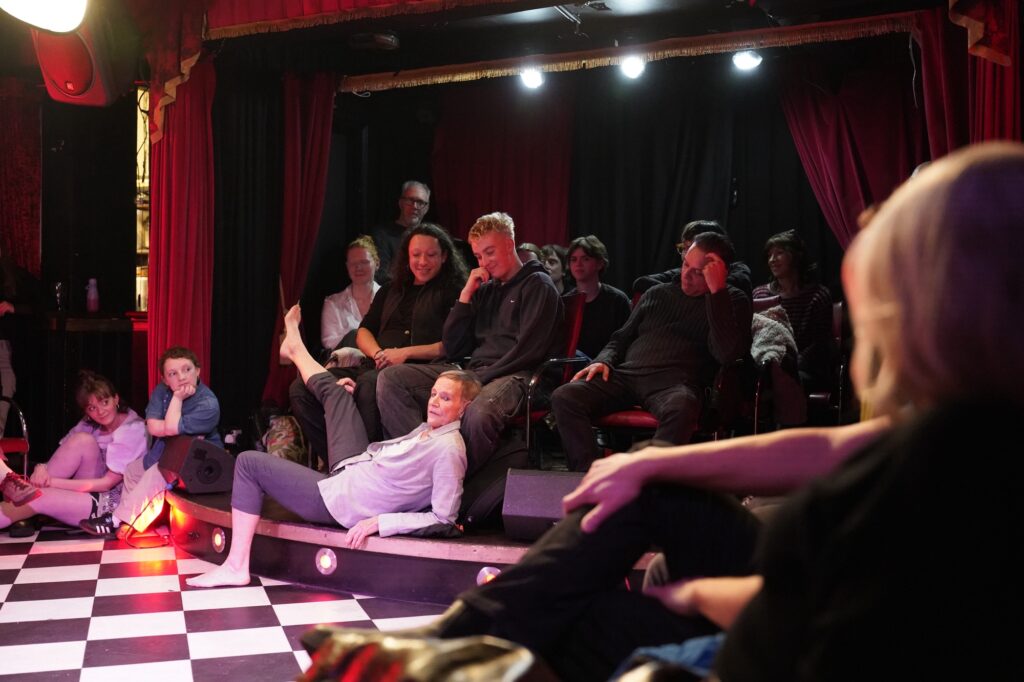
Throughout this evening of performances, it is apparent that improvisation becomes a tool for processing and reflecting on our past, present and future life experiences. A fluid way to take artistic license of our narratives and perhaps author new realities that may just illuminate or even offer healing.
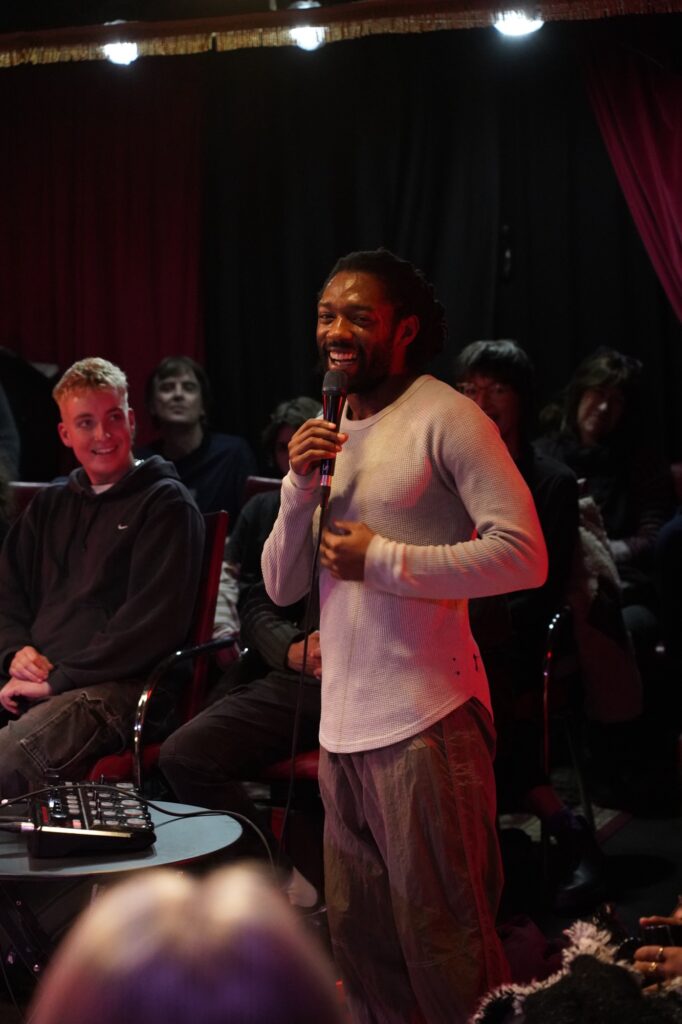
Akeim Toussaint Buck offers a playful and nuanced take on his lived reality. As an artist, Buck’s work is never void of social commentary and this solo follows suit, with the acknowledgement of the self as political.
As his solo opens, his loop station (a musical device) is established as an anchor rhythm throughout the work; a rhythm which the body can exist parallel or in contrast to. Rhythm and breath can also be seen as a way the performer lands and prepares themselves for the ritual of improvised performance.
Again, through text Buck moves around the invisible ‘thing’, which in this context can be read in relation to our everyday lives and here; performance or creation. The spark, the seed, the thing that captivates us and therefore, we yearn for.
The score which Buck creates with his voice and loop station creates an otherworldly plane allowing him to negotiate momentum and stillness, an earnest reflection through dialogue. He becomes almost like a sonic transformer shifting between different expressions and melodies. The comedy in Buck’s offering is in the fortuitous moments where what exists in space meets memory, identity, culture or desire i.e. milking cows and a bottle of Jamaican coconut milk. This humour allows for impactful socio-political commentary such as how Buck is able to walk through a park safely at night because everyone is afraid of him as a Black man. Commentary that stirs laughter in the audience yet alludes to an age old prejudice against Black men. Buck’s final segment is performed to a melody chanting the words ‘Staying in the game’, a firm reminder to persevere, regardless of what life may bring, of what cycles we may meet.
Théïa Maldoom Founder of MTG values care as a core value within her practice, and this consideration is honored throughout her performance with Seke Chimutengwende, who she co-curated the evening with.
We are instantly captivated by their attire, a sparky silver dress, leather trousers and a fur gilet; an eclectic duo that immediately asks us to trust them as characters. ‘In the beginning there was disco’; they converse together in the space, a verbal tennis match of word associations, rhymes and stories. Maldoom is mischievous and Chimutengwende is grounded as they negotiate the world of the revolving disco ball.
Their performance style is fascinating to watch as it constantly shifts between heightened emotional performance through text and the voice, alongside at times, pedestrian movements. They seamlessly and carefully tread attitudes towards current realities uttering ‘Fuck those in charge’ and pensive reflections on the art world through their thoughts on being emerging artists ‘…on the edge of a breakthrough!’
One might argue that improvising in a pair is much more complex than doing it on your own. However, the meeting point between the two worlds of experience and expression make for a thrilling ride. Watching this pair feels like watching two sides of the same coin; they search for meaning together, they create meaning together and hold the world, their world, together, before us.
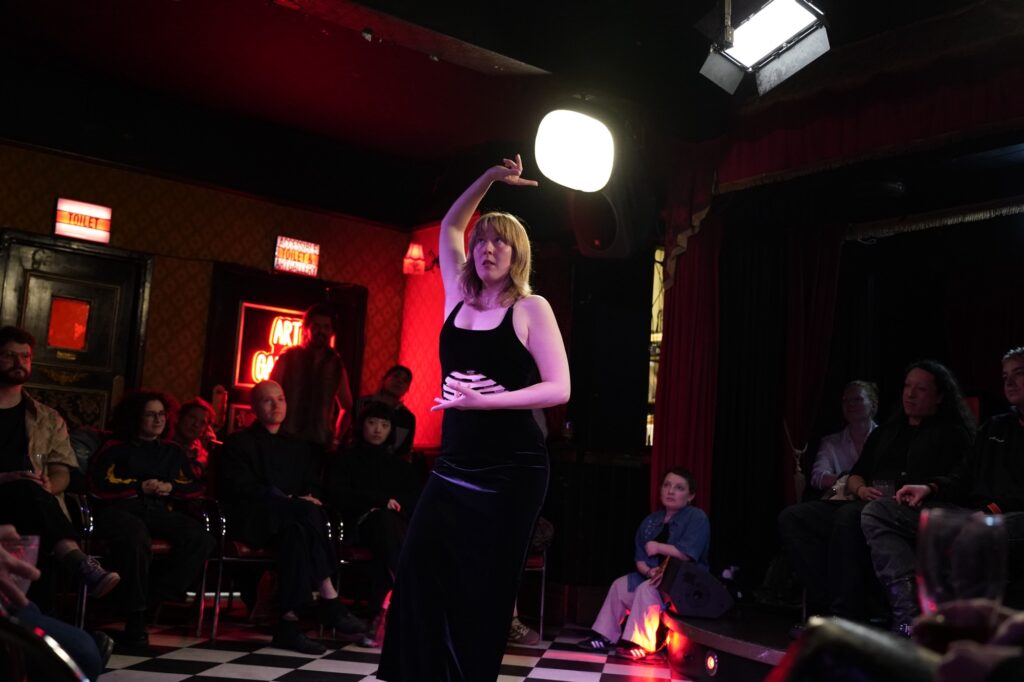
Devoted to the art of being, Laura Edwards’ dedication to presence is amplified through her overt acknowledgment of the audience. Through her gestures, Edwards illustrates the invisible space for us, allowing us to imagine and co-author this story we bear witness to. The performer teases us with a reference to her grandmother that perhaps conjures up new characters for us in other worlds. This extension of story beyond the performance space offers a contextual gravitas for the performer or character. As a whole Edwards’ performance quality is serene, leaning into the stillness of the room, while creating space for the honest performer to breathe.
As a first time audience member at MTG, I felt positively inspired, soothed and activated. A night of improvised performances that not only allowed for joy but an opportunity to reflect on how artists are truly experiencing their lived realities, even if only a taste.
Improvisation is so much bigger than just what we produce in performance spaces, it is a vehicle for transformation through live processing, it is a tool we have no choice but to hold near as we journey through unchartered worldly territories.
MTG continues in 2026 with its next evening on the 27th February at Chisenhale Dance Space. Book here.
Photos by Julia Testas.