Words by Lizzy Tan.
Resolution festival’s January 10 triple bill at The Place presented diverse perspectives on the pulse of contemporary dance in 2026. Humble Power, Quiet Might by Maya Inniss is a contemplative demonstration of her multidisciplinary creative practice. Supermarket Shenanigans brings Ty Burrows cheeky sense of humour to unpacking the absurdity of contemporary life. Closing the evening, Where What Never Was by Aurora Casatori highlights her immense technical range and interpretation of the subjectivity of memory.
Humble Power, Quiet Might by Maya Inniss
Humble Power, Quiet Might begins in darkness, haze filling the stage. A narrow spotlight illuminates a glowing rectangle (a keyboard?) in the downstage left corner. Printouts of Inniss’ poetry were passed around on small cards in the pre-show, establishing Inniss’ approach to integrating spoken word into performance. Inniss emerges as the lights intensify, walking slowly toward the lit rectangle to the sound of crashing waves. The ensuing tension – anticipating what exactly happens next when Inniss does breach the keyboard’s halo – introduces how Inniss employs objects as co-performers in this spoken word-performance art solo. Inniss’ movement quality is serpentine, drawing the audience’s attention to details like her tendril-like finger articulations.
‘To be an artist is to… perceive…’ she tells us. Inniss’ poetry features in the sound design and in the live performance. Near the piece’s end, Inniss approaches an altar of sorts (a large rolled-up canvas, art books ranging from Van Gogh to Magritte), ultimately unfurling the canvas with gentle prods. The title, ‘Humble Power, Quiet Might’ is painted at the canvas’ extremity, and is echoed in the recording. Through a kaleidoscope of different mediums, Inniss presents herself as someone for whom poetry, movement, and visual art are inseparable: a promising portrait of multidisciplinary practice that invites deeper synthesis. A clearer through-line might distinguish what each medium uniquely contributes to Inniss’ practice – why the poetry must be poetry, why the movement must be movement, and what these together reveal about ‘perceiving’ as an artist through Inniss’ lens.
Supermarket Shenanigans by Ty Burrows
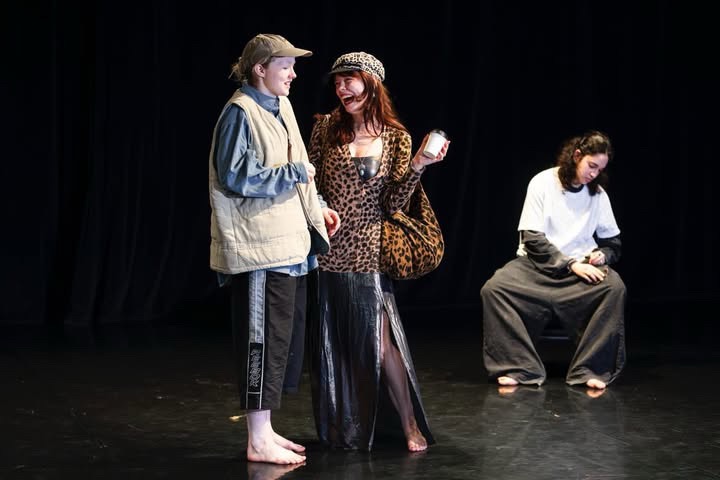
Ty Burrows’ Supermarket Shenanigans opens with a chirpy ding! and equally chirpy voice welcoming viewers to the fictional ‘Lion Mart,’ a stand-in for any one of the ubiquitous supermarkets which define contemporary life. What follows is a frenetic carousel of parodies. Performers Carys Belle Thomas, Noor Darwish and Amelia McCulloch inhabit a cast of heightened caricatures that occasionally tip toward mockery rather than curiosity. Developing a few characters more fully might elevate the work into genuine social commentary.
There’s a sullen store employee who interprets requests (only) literally, the almost-meet cute between someone searching for love and someone searching for Uncle Ben’s microwavable rice, the physical manifestation of an energy drink ad, a yummy mummy and stoic single dad, hen doers, teen angst robed in a karate uniform and a maladaptive daydream, and a secretly posh roadman, whose ‘mask’ is an allegory for the whole performance: the personas we put on to coexist in public space. There are a few more structured dance sections, including peppy unison choreography and an oscillating, in-and-out-of-sync walking phrase featuring performers moving past each other like ships in the night. Using exaggerated characterisations, Supermarket Shenanigans points out the absurd choreography of our lives.
Where What Never Was by Aurora Casatori
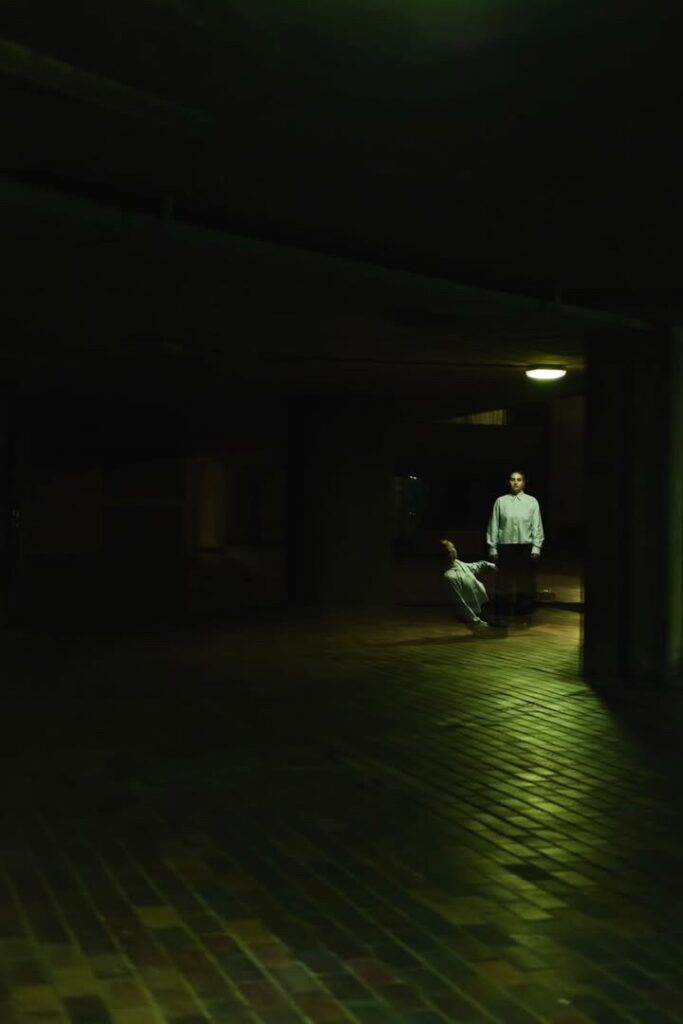
Choreographer and performer Aurora Castori explores the ‘lingering ache’ of memory’s imprint in Where What Never Was. Castori is illuminated slowly, as if cinematically revealing an automaton. Castori’s face is obscured by a dark hoodie and she is dressed in wide-legged jeans and black trainers. Rotating on the spot like a music box ballerina to a tinkling, eerie melody, Castori sets up the first of many illusions in Where What Never Was. In another moment, Castori’s tense, twitching movements against Seirian Griffiths’ sound design and flashing stage lights create a stop-motion effect.
The symbiosis between lighting, sound, and movement propels much of the choreography’s glitch aesthetic and drama – it feels part Black Mirror, part cyborg body horror. Castori’s fluidity and range are impressive. She easily inhabits drastically different physicalities, from floor work to contortion and ballet. Her interest in the subjectivity of memory is most apparent via repeated and deconstructed motifs, methodically revisiting and degrading phrases. The piece is technically impressive and visually striking, yet one wonders what lies beneath Where What Never Was’s cool shell, and what Castori ultimately wants us to take away from memory’s fragmentation. Is she asking us to feel, kinesthetically, the concept of memory’s imprint? Or is there a more pointed statement waiting to emerge: that memory’s instability is something to fear, that our forgetting is a casualty of increasingly mechanised times, or that human recall has become inseparable from digital processes?
We’ll be posting more reviews of Resolution performances so keep an eye out on our website! Header image: Amari Webb-Martin.