Words by Karly Benson.
Over the past decade, Dance Data Project (DDP) has pioneered a new field within the dance industry, bringing research, reliable statistics, and surveys to the global dance community on topics including compensation, leadership, and revenue across ballet and contemporary companies.
Founded in 2015 by Elizabeth Yntema in the United States, the nonprofit emerged in response to the noticeable lack of female representation in choreographic positions, aiming to advocate for equity through data-driven research.
In response to these gaps, DDP has released 65 publicly available studies, driven by a relentless focus on detail and a willingness to embrace innovation rather than shy away from it. These surveys provide accessible, unbiased data on segments of the industry that many have questioned — or never even considered.
I spoke with Nancy Dobbs Owen, a senior DDP member, dance professional, writer for the LA Dance Chronicle, and university professor, to discuss DDP’s mission and findings from their seventh annual Global Leadership Report. The survey examines leadership metrics of classical companies in both the U.S., and internationally, and presents a revealing picture of gender inequity and male dominance across the industry.
The report surveyed a total of 213 ballet and classically based companies across more than 60 countries, analyzing the gender distribution in critical leadership positions including artistic, executive, associate/assistant directors, as well as heads of schools, heads of second companies, and rehearsal directors. Additionally, for the first time, DDP expanded its analysis to include music directors and principal conductors.
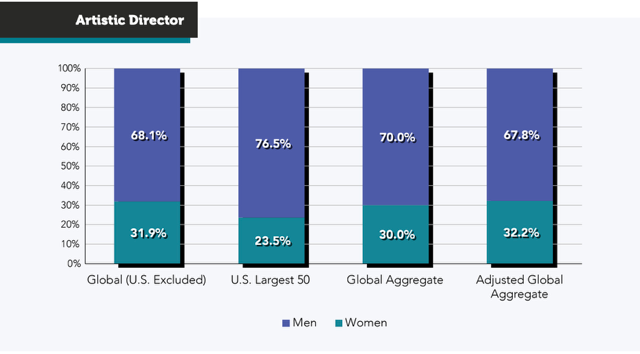
“Of 217 artistic directors in classically based companies worldwide, 152 (70%) of them are men”
– DDP research
While the data is illuminating and, at times, unexpected, it is just that — data. As Nancy explains, “We just pull the data; there’s no value judgment on it. We do not get into the artistic sensibilities of companies at all.” In an industry driven by emotion and lived experience, DDP seeks to separate emotional response from data analysis.
Instead, their mission is to publish data in an accessible way, allowing industry members to do their own research and investigate not only why the numbers are what they are, but why they may be trending in a certain direction.
In pursuit of unbiased simplicity, the data undergoes multiple layers of revision before publication. Every detail, from verbiage and typography to colour and graphic design, is carefully considered, aiding clarity and comprehension, particularly for long, data-heavy documents.
Being the first of its kind, DDP has grown immensely by intently listening for feedback and implementing protocols, including the use of WWL (What We Learned) documents. Working at the forefront of the industry, they capture questions, challenges, and insights from the onset of their work, setting the standard for research in the dance industry. They have also taken a unique approach in the performing arts sector by hiring staff with STEM expertise.
In doing so, they are able to use coding to enhance accuracy and have developed two proprietary algorithms that automate the collection of annual IRS returns in the U.S. DDP continues to build on these efforts, expanding their areas of research to further deepen and broaden insights across the dance industry.
Whether a company is considered ballet or classically based is often determined by its own description, accounting for organisations like Alvin Ailey that operate in both contemporary and classical spaces.
DDP is in increasing dialogue with these companies, many of whom are eager to be included in the surveys, and sources its data directly from them via websites, programs, descriptors, or direct conversations with artistic and executive directors. “As we’ve grown and gotten bigger, companies are much more inclined to work with us — they want to be listed and ranked,” Nancy said.
The Global Leadership Report 2025 offers a sprawling and alarming reflection of the recurring imbalances in leadership across the ballet industry. While some figures feel predictable, others are surprising. Reading through the survey, I experienced exactly what DDP intended: access to unbiased data that allowed me to draw my own conclusions — findings that both affirmed and challenged my preconceptions — without suggestive language, neglected information, or exaggerated headlines.
The survey captures leadership roles in the largest ballet companies internationally.
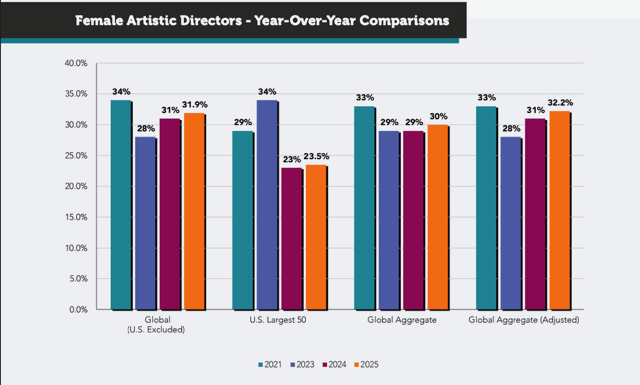
To create an accurate global representation, statistics are divided into sections; Global (excluding the U.S.), U.S. Largest 50 Companies, Global Aggregate (Global companies plus Largest U.S. 50), and Adjusted Global Aggregate (Global companies plus Largest U.S. 10).
While the data is thorough, key findings reveal clear patterns of inequity. Of 217 artistic directors in classically based companies worldwide, 152 (70%) of them are men. Among the 11 largest companies — those with more than 100 dancers — the percentage rises to 72.7%, up from 67% in 2024.
Men similarly dominate most leadership roles, including executive directors, assistant artistic directors, artistic directors of second companies, and music directors/principle conductors. However, women hold up to 49.2% of executive director roles, and are the majority in roles such as heads of schools and rehearsal directors. This raises an interesting question as to why women exist more in these positions than others — a question DDP leaves to the reader to consider.
Another notable finding can be found in the 2025 Global Resident Choreographers Report, which examines 440 international companies in both the contemporary and classical sectors. Overall, men continue to hold a slight majority of resident choreographer positions. However, further analysis reveals important patterns. When separating the data by sector, women hold a majority of resident choreographer roles in contemporary companies (57.1%), but are significantly underrepresented in classical companies, where they account for just 23.8%. Tenure patterns further highlight these disparities.
Among women who hold dual roles as both artistic director and resident choreographer, the largest proportion (52.6%) have served in their positions for one to five years. When these dual-role positions are excluded, men and women are represented equally within the one- to five-year tenure category; however, men outnumber women across all longer tenure lengths. As DDP Senior Research Consultant Junyla Silmon notes in the survey, “DDP’s findings around tenure of resident choreographers reveal a powerful story. Women are increasingly taking on leadership roles — particularly in smaller or self-founded companies — but the path to sustained recognition as a resident choreographer remains steep, especially for those not in artistic director positions.”
Although the surveys contain extensive and complex findings, DDP’s continued commitment to making data public and accessible ensures that opportunities to learn, interrogate, and make changes in the industry are stronger than ever. Beyond their research, DDP uses their platform to highlight female artists, working with affiliates such as Maestra and Rise Theatre Group. “Our Instagram is 80% highlighting other people’s work,” Nancy said. DDP is also introducing innovative funding methods — responding directly to the needs of female creators — such as supporting childcare initiatives, amplifying regional companies, and the work of newer, less known female choreographers.
DDP addresses a notable gap in an industry long lacking unbiased, accessible data. Guided by a solutions-driven ethos, one that identifies problems and works actively to address them, the organization remains deeply committed to serving the wider dance community. This commitment is reflected not only in the absence of paywalls and a willingness to broaden their scope of research, but also in its launch of a new nationwide initiative, funded by its first large foundation grant, to connect professional creators both onstage and behind the scenes. Engaging with the report underscores the value of data that neither simplifies nor steers the reader toward a predetermined conclusion, instead inviting closer attention—to the numbers, the industry, and the assumptions that too often go unquestioned.


We are hugely grateful to Karly and DDP for wanting to publish this research on our magazine.