Words by Maxine Flasher-Duzgunes.
San Francisco, CA — From the loft studio of one of San Francisco’s permanent homes for contemporary dance, six Bay Area choreographers presented new works excavating the effects of lineage on the mind and body, what moves us between instinct and choice-making, and what still lingers under the soil. As part of ODC presents Pilot 75: DIG, each artist was mentored in not only the choreographic process, but all the elements of production, design, and outreach involved in an evening-length performance.
The first work, Crossing, choreographed and performed by Ria Fifield, considered how scenography can illuminate the world of the stage as well as the inner world held and carried by the dancer. Three large sheets hung across the space, at first creating the illusion of a bedtime story as Ria’s silhouette flooded the back-lit canvas with sharp yet melting gestures. When the light flickered off and she began traversing underneath the sheets to the reverent strings of a folk song, I was reminded of a countryside house with laundry drying in the backyard, a landscape perhaps from her life long ago. As she began tearing the sheets off the wire and wearing them in elaborate configurations – as a skirt, a headdress, a blanket – it became clear she was traveling through many lifetimes, the fabric bearing identities that she’d both worn and shed. After she catapulted onto the sheets like airy beds for her to lay, she finally placed one sheet atop the wire, becoming the canvas for slowly moving clouds and recreating what world would await her in the next life.
Tracey Lindsay Chan’s work, hypnagogs (the title in reference to the transitional state from wakefulness to sleep), was a group work in contrast and interrupted the space with an assortment of wooden chairs, the lights dimmed golden-yellow like the edge of evening. As one dancer dozed, the others counted coins out of a jar and furiously scripted messages on their palms, as if crafting imaginary tales before they all drifted into dream states. The partnering that ensued after this scene was reminiscent of the complex braiding of a rope, arms that tangled out of their fine blue silks only to be puzzled back again. The distant sound of trickling water also seemed to lull the audience as the dancers unraveled the ribbons of their limbs effortlessly to the floor. When the Roy Orbison song played, the room perked up, wondering whether consciousness had returned, and the dancers’ animated faces shone like stars that truly belonged in this whimsically surreal world.
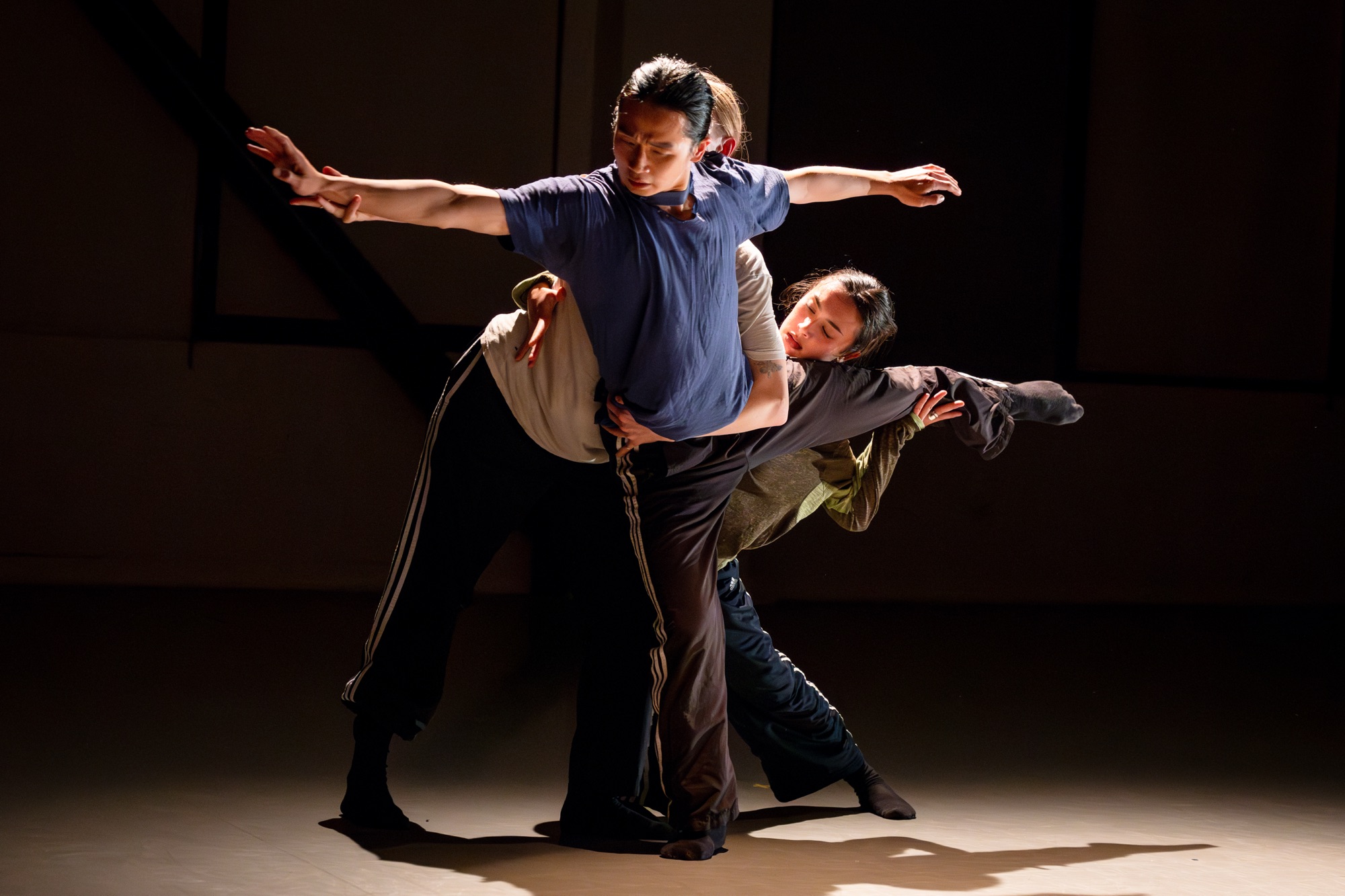
Alice Svetic’s piece, BUILDERS, constructed a powerful quartet of seamless flow and minimal design. As an inseparable unit, the dancers remained in the constant process of sculpting something that would often collapse, and not into ruin but into uniquely reformed structures. The precision of their fingers elucidated the image of a drill or screwdriver, piercing holes into the space between one another like nails into wood planks. Even the angled movement sequences contained a softness that would either end on the floor or in a lift, complemented by the dancers’ supple athletic clothing that landed into each surface with ease. The quartet’s trajectory frequently involved breaking the form of a box to form a trapezoid, then a line, then two duets, and continued as such until they all converged downstage, stacked atop each other like bricks, awaiting their next instruction.
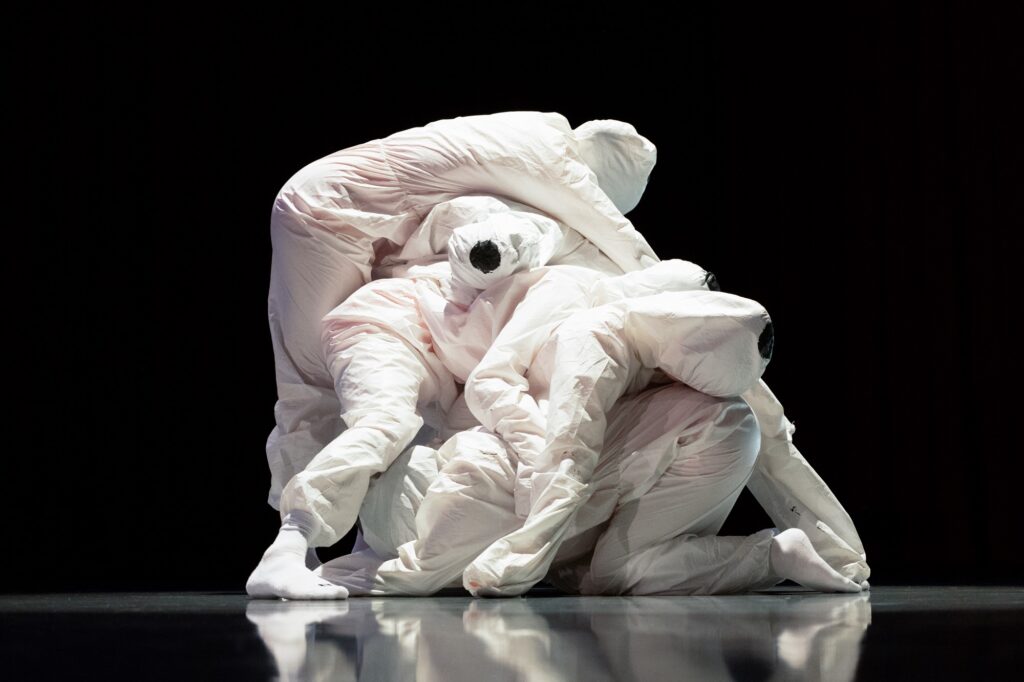
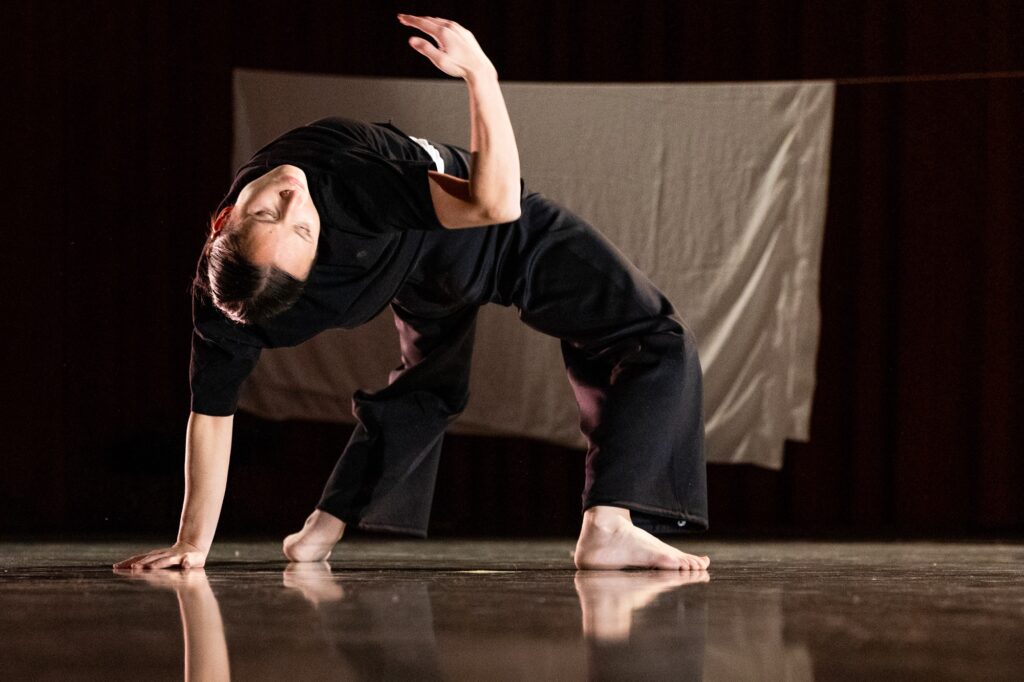
Following intermission was eye-mouth-eye by Kat Lin, comedically classified by its tyvek body suits, glued-on googly eyes, and flashy red unitards. Instead of using the preferred stage entrance, the dancers conveniently rolled from underneath the curtains surrounding the space, sometimes solo and at other times in unison like a swarm of rolling pins until arriving at centre. Upon forming a clump, the dancers would either break out and writhe as if to rid their body of a bug, or make prolonged eye contact with members of the audience. At one point, they stared altogether across the fourth wall, sticking out their tongues and making faces as if part of an illustrious message sent out by a computer virus. The digital sounds of blinking eyeballs would accompany these odd goggling moments, then broken up by outbursts in the crinkly fabric which they eventually stripped away altogether, hinting at where they might go next on their journey of both fantastical horror and horrific fantasy.
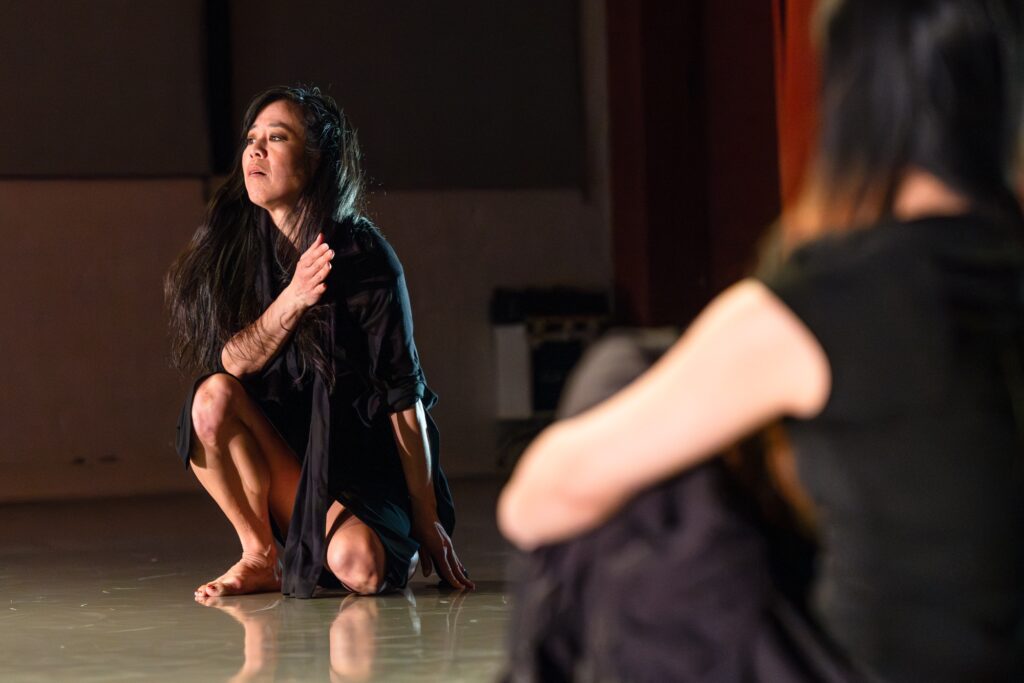
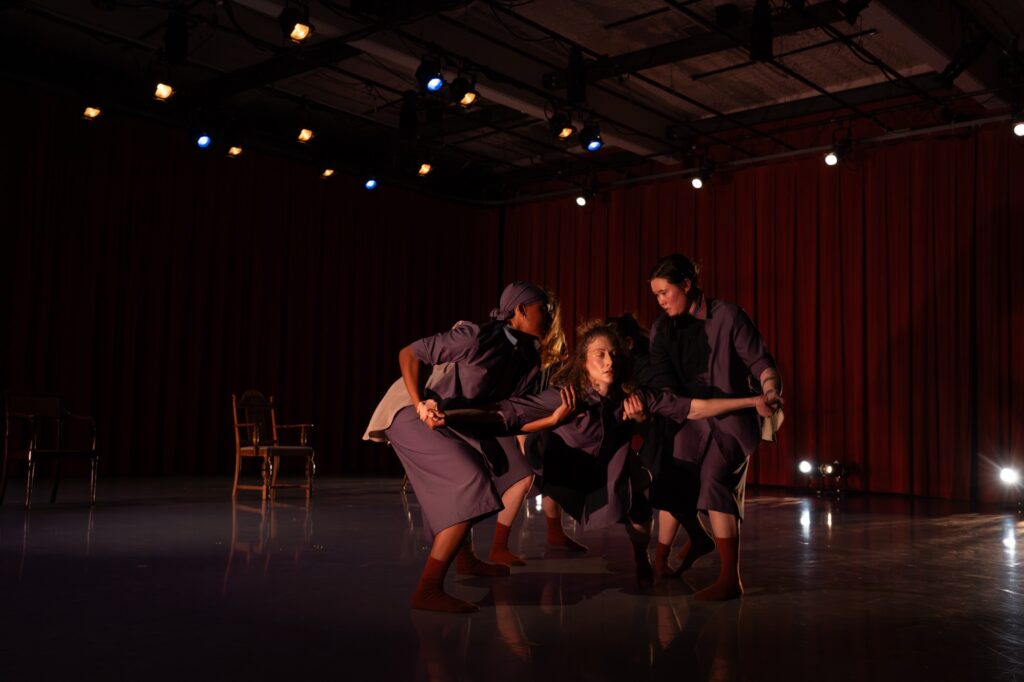
Eli Shi’s work Run all the way home, featured an intergenerational cast playing the roles of Grandmother, Mother, and Daughter in a homage to Little Red Riding Hood. Despite at first moving solo in an estranged space from one another, each dancer seemed to carry the essence of the one that preceded her – a hand to the mouth or a delicate pull of the arm from high to low. All in black garments that both bounced and draped off their swirling adagios, the dancers seemed to walk the same path yet on different toes, in different times. The phrase “chocolate in the wolf’s mouth” stuck with me, as the textual narrative described Daughter’s unrecognizable return, bringing clothes too big to wear and headphones not enough for her mother to hear from, as if distance and time had pulled her away from knowing what could fit anymore. In the piece’s last moments, the dancers joined in harmony to the velvety melody of a live guitarist, finding serenity in the brushstrokes of their fingertips and waltzing as one into the fading light.
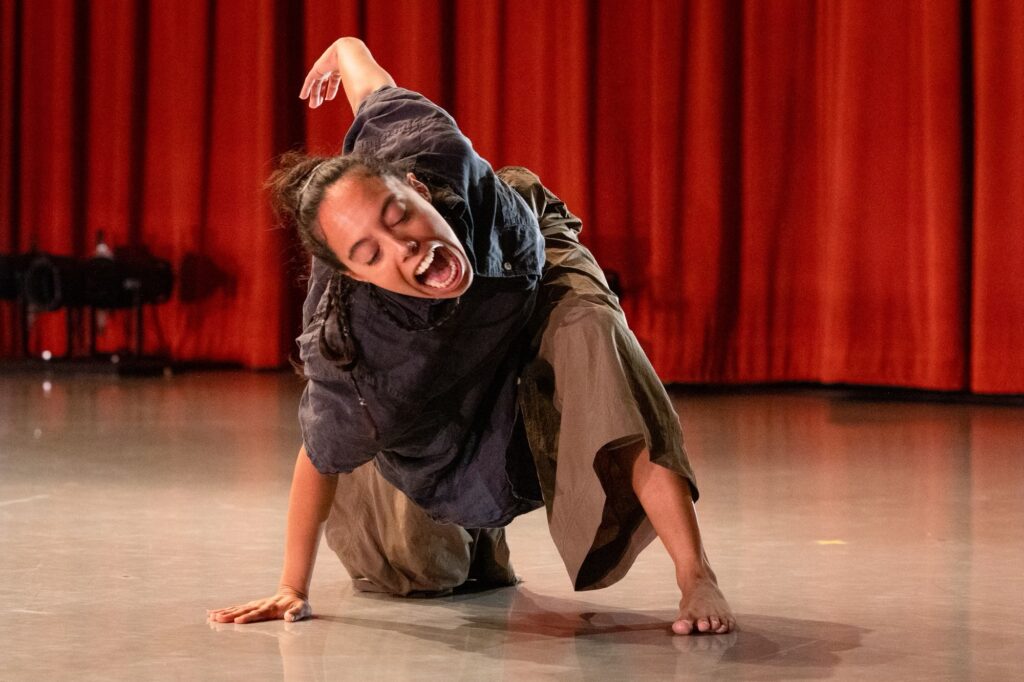
Flood the Garden by choreographer Gabby Wei finished the programme with an experiential whirlpool of floorwork and beautiful control of balance and breath. While each of their pathways ebbed and flowed throughout the space – stretching the limits of their appendages and the corners of their lips – the dancers defined their home base by a diagonal formation from upstage right to downstage left. Their bodies would glacially cascade down this line, as if plants growing on time lapse, and silently yawn in the elastic seconds before arriving at their next spot. In the background was a sound like wolf howls inside an electronic terrain, which at moments motivated the eager sweeps to the floor and the group contact improvisation that took place thereafter. In their gentle crawls and tumbles to and from the diagonal and then each other, the dancers unearthed this quality of renewal, that within the confusion and ugliness of growth and change there is indeed grace and awe being sewn onto its lining.
To learn more about the ODC Pilot program and the choreographers, visit odc.dance/pilot or follow @odcpilot on Instagram. Header image of the work BUILDERS. Photo by Simone Rotman.