
Words by angel dust.
Monika Blaszczak since I first came across her art, is someone I consider to be a professional shapeshifter. That is not to say that Monika and her work are incoherent and cannot ever be known, but rather point to a constant mutability or migration that Monika adopts as a human and an artist.
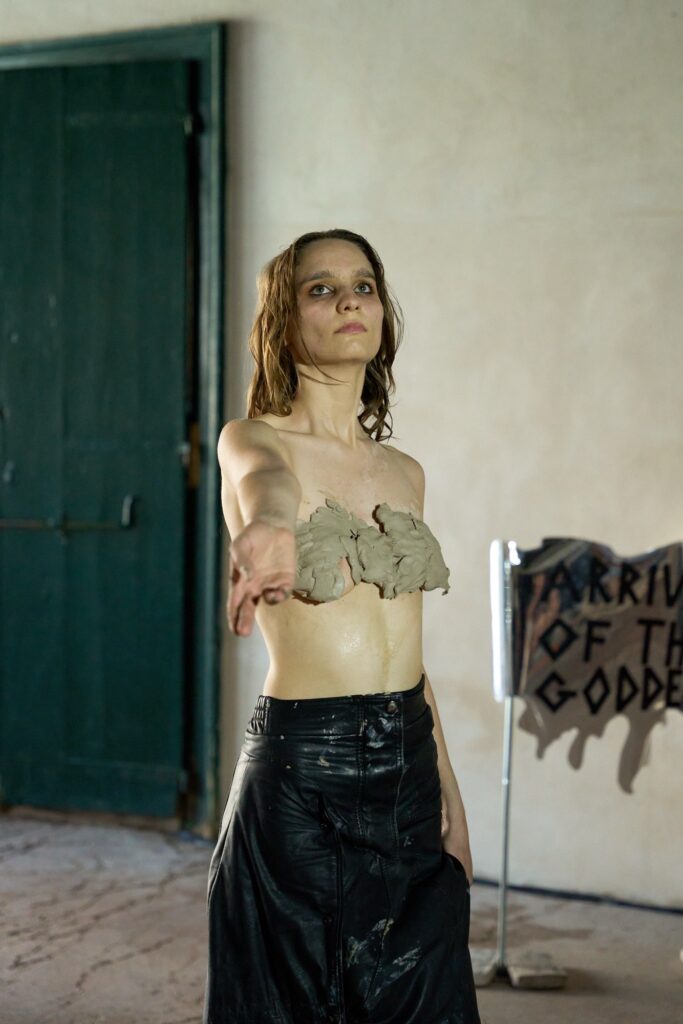
This perpetual transformation is the subject of all myth and is also the subject of Monika’s latest piece Clay. Premiered as a solo piece in Venice in June 2025 as part of a two day immersive event Memories of Water, Memories of Air by Arts Territory (curated by Kasia Sobucka), Clay was further developed and performed as a group piece in Poland in July of the same year.
Clay draws a parallel between the body and clay as archives of time and memory. In a quiet yet epic manner Blaszczak taps into those archives while presenting herown cosmology, one that highlights the cyclical nature of being and of becoming.
The space in Clay acts like a theremin; the performers movements casting spells that uncage primordial sounds from the earth’s deepest caverns. The undulating swivelling brachial movement of the upper body are contrasted by the jagged cautious trudging, Monika’s legs constricted by the long black skirt they are wearing. The piece gracefully achieves a balance between the ethereal and the earthly, the harmonious and the violent facets of being alive and of the desire to create and shape the world around us. Clay ultimately reminds us that what comes up eventually needs to come down and that embracing death is entrenched with materialising fertility.
Monika guides us through these philosophical ruminations in the form of chapters that help anchor ourselves in the mythology of Clay. However, avoiding a clear-cut narrative Clay is committed to mystery as the means to attaining knowledge.
Overall the piece oozes sensuality since a core tenant of Monika’s practice is finding pleasure in the context of a dying world, or to take it a step further, making love to a dying world. I think Monika aptly lends herself to this pursuit of a pleasure that’s rooted in care and connection rather than self-centred hedonism. It is this genuine kinship with the world that her art aims to cultivate.
I connected with Monika recently to discuss more about her journey leading to Clay as well as find out more about her newly founded company Monika’s Dance World (MDW).
AD: Monika, tell me, why Clay?
MB: A few years ago, I read “The Parable of the Sower” by Octavia Butler. It’s a book that really, really moved me and the metaphor of clay is very present in it. While reading this book I felt some kind of long path unfolding in front of me that the book inspired. There is a quote I will read for you: “As wind, As water, As fire, As life, God Is both creative and destructive, Demanding and yielding, Sculptor and clay. God is Infinite Potential: God is Change.” – Octavia Butler. I think this is something that really stayed in me.
And then, three years ago, I was participating in this fantastic residency in the Atacama Desert. It’s called La Wayaka Current and it’s a residency that tries to facilitate a dialogue between the indigenous community called Likanantay living in the desert and the contemporary artists in the context of the climate emergency. While I was on that residency, I had a very powerful experience, I was working with clay for the first time, and there was something about that visceral experience of molding clay and receiving the landscape of the desert, that felt so eternal like I was literally in the presence of God. There were no jumps between my being and the being of the desert, and the being of the clay, it was all one. It was very clear to me then that being alive and embodied is a very mystical and deeply spiritual experience, and that God, or in other words a dancing cosmic omnipresence, was in this act of creation, as the possibility of change and transformation. To me, clay is a super beautiful metaphor of that.
AD: It is funny how one needs to travel far away to access that sort mentality or headspace that you are one with a landscape even though you may have never physically been there before. I suppose the desert landscape really lends itself to your practice of Soliloquy as well, in that the sparseness and lack of distractions really gives space to whatever ghosts you need to commune with inside you.
MB: It is true. And of course I felt that kind of oneness with the the nature where I come from – the Polish forests that I grew up in – but there was something about the foreignness of the desert that must have triggered some kind of different awakeness or sensitivity to this moment or being. Also, there is something about the unique landscape of the desert that affected me so strongly: the open, unending space made me feel like more space was carved out inside me too.
During that time, I really experienced the earth as a living breathing body that has its own memory and ghosts and I was just very moved by the sensual experience of Earth’s body and my body coming together. So that’s where these ideas sprouted and then my process for the dance piece took place in a completely different environment. Clay was created in Berlin, it premiered in Venice and it was then further developed in Pozna? in Poland. So it also connects these different environments and landscapes which are all somewhat in different ways affected by the climate crisis.
AD: Clay begins with the arrival of a goddess. Who is this goddess?
MB: So first of all I would like my answer to this question to not dictate how the audience members experience the goddess in Clay. I would like the audience members to have their own journey with the goddesses. But what I can share is my own journey with the goddesses and what happens to me and to our team during the creation process.
So each one of us (the dancers) created our own goddesses, which are kind of an expanded and fuller versions of ourselves. The versions of ourselves that are divine. We have done a lot of work in the rehearsals on visualising those goddesses. We spent a lot of time understanding what they look like, what they move like, how they talk. What is important for them, what do they believe in? How do they fight and create?
So each one of us has done this process of visualising her own goddess and then embodying her. And those were pretty powerful and moving processes because we realised that the goddesses already live in us and they are available to us at any point. The inner wisdom which lives in our flesh is already there, ready to be tapped into. I personally feel that the most direct way to access this wisdom is through dancing. This was a process of becoming more of what we desire to be. But again, I want to emphasise that there are many meanings and sensualities that can be unlocked with the goddesses for each of the audience members and I would like possibilities to remain open, and I really wish for the audience to have their own journeys with this.
AD: In your piece Mourning Songs you work with the theme of eco-extinction and the performance takes place on the banks of the Cybina river in Poland. Here you touch upon the idea of grieving as a life affirming process. In Clay you give birth to a new world that ends up being engulfed by fire. I am interested in the relationship between generative forces and destructive forces or more broadly order and chaos in your work and how do these inform the chronology of these pieces?
MB: You are pointing to a fascinating tension between generative and destructive forces. What I want to offer is that these forces are not opposites of each other, but rather they are a continuum or a spectrum – or a specter! And in my work, I am very interested in spectrums and specters. One can always search for order in the chaos or for chaos in the order and in my choreographic work I’m certainly fascinated by the possibility to shift between those two organisational structures, both in the contents of the work as well as in the choreographic form or even the production formats in which the work is created.
And here the image of fire feels relevant to me. Fire as both destructive and generative. On New Year’s Eve, I chose fire as an image, a symbol, a force and an element to follow this year for myself and I guess I am following it with Clay. So to answer your question about the chronology of Mourning Songs and Clay I am interested in non-linear time rather than a consecutive timeline, but these pieces feel very close to each other in the ecosystem of my work as a whole. Even in terms of the group of creators, one of the dancers performs in both of the pieces.
I feel that in Clay I am just older and I want more. I want more of everything. And I am more unapologetic in what I search for in the work. And what I want the work to bring out of me. Or rather, what I allow the work to bring out of me.
AD: What other ghosts were present in the making of the piece? Or what other forces, places and times constitute the mythology of Clay?
MB: In this piece there are many different forces, many different movements that we are in contact with. I hesitate to name those forces, because the moment I start, I inevitably leave out others whose absence would feel like a loss and a betrayal. So, it seems more fitting to remain humbly silent about all the exact names of those forces.
However, I will mention one force that has been very present for me in the making of Clay and in my life at the moment, which is love. In recent years, I have come into contact with love as a force and with its transformative potential, and if there’s anything that I believe in at the moment, it is really love. And by love, I do not mean some sweet sugar coated thing. By love I mean, even though it might sound a little bit esoteric or mysterious, the fact that there is something rather than nothing. The fact that we are alive. The fact that there is a world and that we get to breathe in it. And that is a kind of force and a kind of situation that I find truly mind boggling, very moving and beautiful.
In the creation of Clay and in the creation and in the work of our newly formed dance company, Monika’s Dance World. The word “company” stems from Latin “cum panis”, suggesting that to be companions means to share bread with each other. In MDW, love or the omnipresent cosmic dance is the bread we share with each other, our audiences and collaborators. I would like all our current and future projects to be driven by this very force called love.
AD: Tell me more about your collaborators in this piece.
MB: Clay was created to an existing piece of music which is “Lamunan” by Antonina Nowacka, a fascinating and accomplished young musician from Poland. “Lamunan” was created in a cave in Java and later recorded in a fortress in Poland. What inspired me to work with this piece of music was this hauntingly beautiful layering of Antonina’s voice and it’s echoes, and a somewhat ancient feeling in her music. It is a real honour for me to create a dance piece to Antonina’s music.
Costumes and set design were created by Marta Szypulska, an incredible artist based in Warsaw whose imagination really exceeded any of my expectations. She’s an absolute rock star and everybody should be working with her. And in the group version of Clay, I was joined by two dancers: Ramat Musa and Misia ?urek who are also part of Monika’s Dance World. I’m deeply grateful to have such stunning performers contribute their movements, wisdom and fantasy into this work and l’m extremely excited to see what comes next for our team.
These are my artistic collaborators and there are many more producers, curators, managers, friends, family and other contributors without whom this work wouldn’t have been possible and I just want to take this moment to extend my deepest gratitude to every single person who has supported me and my team on this journey.
AD: What are three things that you love at the moment outside your creative practice?
MB: I love cooking more than I have ever before. I am at the moment exploring Polish recipes from my childhood as much as I can. I love getting older, the wisdom that comes with it and the feeling of being unapologetically me. And I also love the sunflowers that I grew on my balcony. There is so many of them this year!
Monika’s Dance World is a dance company founded in 2025 by Monika Blaszczak. MDW is based in Berlin and works internationally. You can find out more about the company at https://monikasdanceworld.com/