Words by Lizzy Tan.
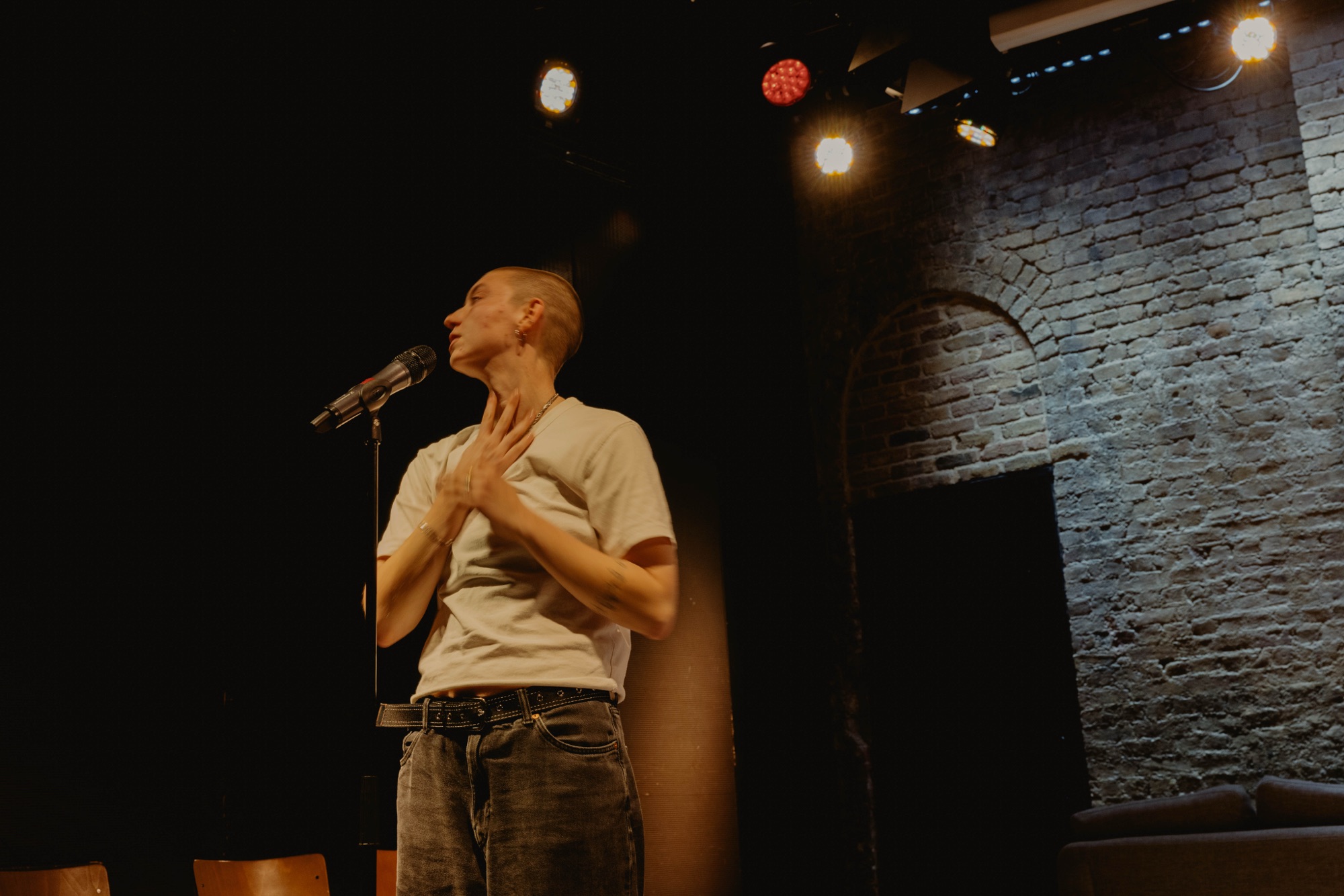
Two people (Daze Hingorani and Alex Whelan) sit facing each other in a tub. There’s a blue wash over the intimate setting of the Roundhouse’s Studio Theatre, and a suit laid meticulously on the floor. The atmosphere is casual. The two mime chatting, hands moving. The lights flicker. Whelan opens a bag of crisps and shares them. The ambient music crescendos, as if scoring a nostalgic montage in a movie. Hingorani raises a receiver (mounted on the tub’s spouts) to their mouth and begins to sing. A pink spotlight glows over the blue wash. Hingorani steps out of the tub, dresses in the blazer and approaches one of the several mics onstage, gesturing toward Whelan: ‘This is my brother, and I need a shovel to love him.’
What does it mean to need a shovel to love someone? Is it to mine the sediment of attachment or shared experience? Is it about digging under the surface to understand what is not said or literal? Or is it that one must bury one’s idea of someone to let them be who they really are? Shovel proposes all three as the duo takes turns delivering pleasantries into the mic, aiming guns at each other. The fact that these are finger guns makes them no less menacing.
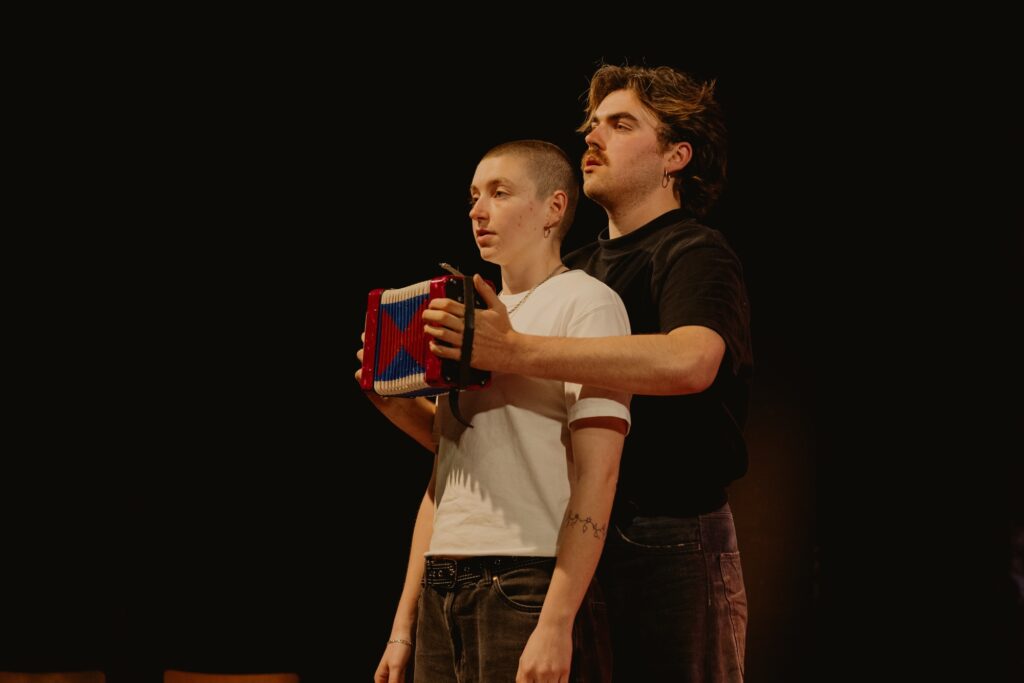
As Hingorani speaks, Whelan holds an accordion, collapsing and unfurling his body with the silently breathing instrument, progressing until the accordion begins to wheeze. There are a few dance phrases in unison, with movement mostly serving as a backdrop to, or physical processing of, the text through sinuous, full-body undulations and hand gestures. This creates irony and divergence from literal readings of the text, giving Hingorani’s well-integrated spoken word poetry layered meaning.
Hingorani composes the world of Shovel through dreamlike tableau. Performers put on and take off their blazers, draw suits on their undershirts, slow dance with a life-size wire figure and challenge each other to balance on the edge of the tub. Later, Whelan rearranges the two’s clothes, then hurls them against the stage wall – the force is an exhilarating contrast to the more restrained beginning. These compositional choices (mirroring, taking turns, confronting each other) invoke a ‘[br]other’ of sorts. The inherent violence in Hegel’s concept of the ‘other’ (the struggle for recognition that defines self and other) provides interesting framing for their relationship, as well as the relationship to self. Hingorani conjures the ultimate, biblical ‘other’ by asking, ‘Am I my brother’s keeper?’ Perhaps the tub over which much of the piece takes place can be read as a womb of sorts – a mother, an ‘Eve.’
There are several references to death and grief in the latter half, though these could be metaphorical: grief as a ‘house we live in,’ recalling a mother in past tense, becoming ‘inhuman,’ and requiring ‘the full attention of mercy.’ Sprawled on the floor, Whelan asks, ‘When I gave you that scar, what did it feel like? Like love?’ Is love itself a kind of scarring – the permanent mark of recognising another’s separateness? ‘I cannot die your-‘ Hingorani cuts off near the end. Read this way, one might think of self-transformation as a kind of death, the old self becoming ‘other.’
Shovel’s programme notes describe the piece as, ‘A bath, a cigarette, a packet of crisps – all shared between two siblings on the last day of earth.’ But what lies beneath this image is a meditation on the ‘other’ness between siblings, between self and former self, perhaps even between performer and audience. Hingorani poses intriguing questions about attachment and recognition, trusting the audience to dig alongside them.
Shovel was reviewed on 28 November 2025 at the Roundhouse’s Studio Theatre.
Credits:
Written & choreographed by Daze Hingorani
Performed by Alex Whelan & Daze Hingorani
Styled by Aimée Blowers
Composed by Tate Hingorani-Short