Words by Sarah Lapinsky.
On a cold Sunday evening that made the darker days dreadfully apparent, I ventured forth to see KIN Collective’s triple bill. Walking up the (many) stairs at Chisenhale Dance Space, I noticed helpful signs encouraging me to “keep going” and that I was “almost there.” Whether or not they were written for this performance, the messages felt like an early welcome into the collective’s world.
In the foyer, I received a programme and observed the buzzing crowd gathering for the relaxed performance/dress rehearsal before the official show later that night. The space was full of families and friends chatting with eager delight. In the theatre, I sat next to a father and his young daughter, both excited to watch their wife and mother perform. The atmosphere felt deeply communal before the dancing even began.
Artistic Director Grace Keeble describes the collective as:
“A self-run company made up of people from various backgrounds who share a passion to move and create… a mixture of professional dancers, former professionals, those who once trained in dance before life carried them elsewhere, people who danced at university and never lost the love of it and others who are newer to the discipline but who bring a deep curiosity and devotion.”
This sense of passion, curiosity and devotion was visible throughout the evening.
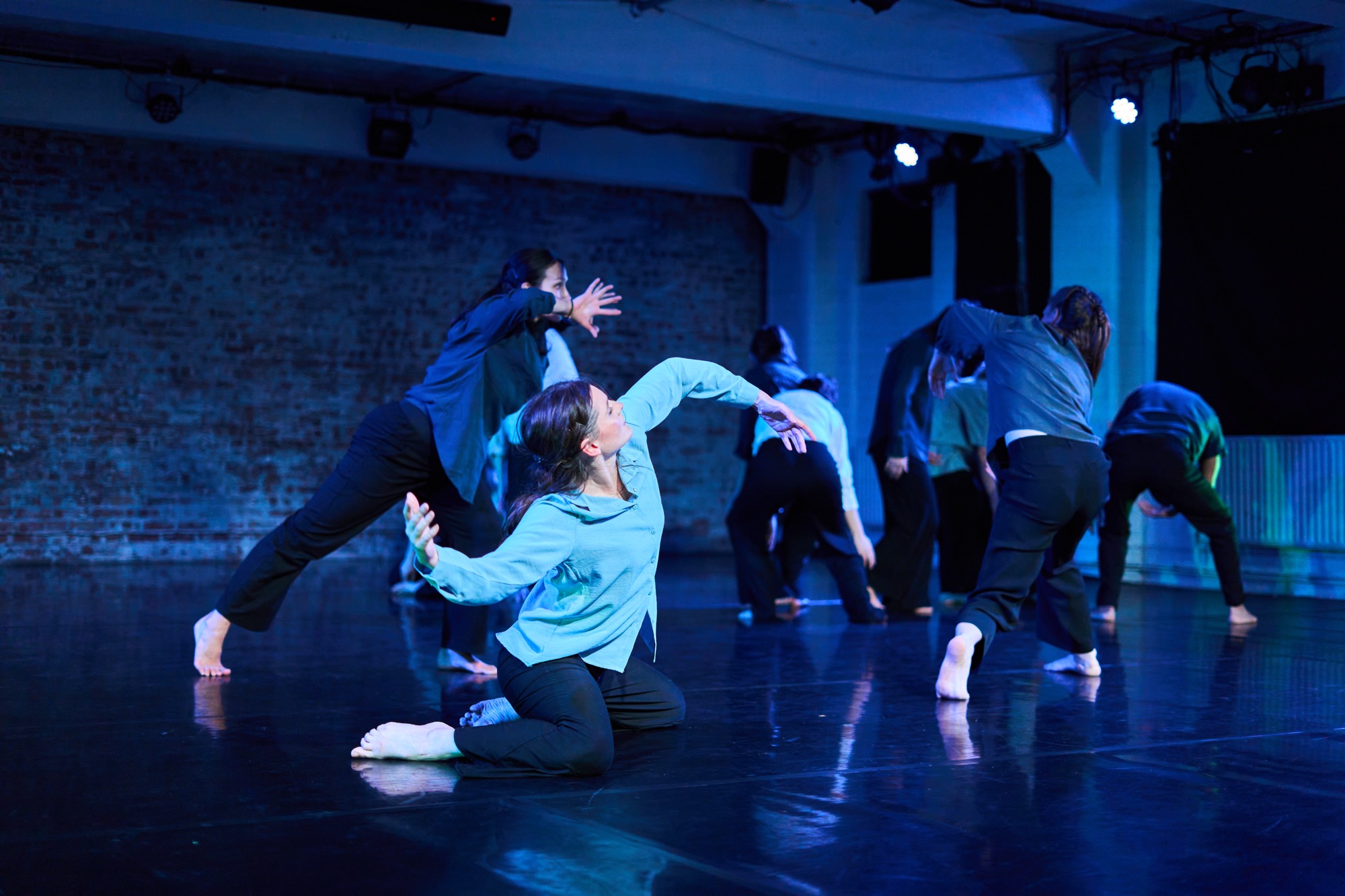
The opening work, Gathering Storms, choreographed by guest artist Petronella Wiehahn in collaboration with the company dancers, explored the weather with dancers embodying and responding to shifting environments. The piece unfolded in what felt like five distinct sections, each revealing imagery foreshadowed in the programme: waves, lightning and currents. These pictures surfaced clearly, yet at times I felt adrift in how the textures connected. Transitions between soft-cloud delicacy and thunderous strength occasionally felt abrupt, affecting my sense of how the dancers related to one another. When their qualities diverged, the relationships between them and the environment they inhabited became harder to read. Even so, several solos grounded the work with clarity, allowing individual movement styles to shine.
Inspired by Tom Hirons’ poem of the same name, Sometimes a Wild God opened with a striking tableau. The dancers began physically connected and expanded this energetically as they breathed together in a unison phrase that felt like a shared pulse. Some movement leaned toward functionality, and I found myself wondering whether a stronger sense of intention behind certain gestures might have clarified the emotional or narrative undercurrents more fully. Still, the moments of cohesion within the group resonated, echoing the poem’s themes of inherited wildness and ancestral presence.
Part I, by guest choreographer Kayleigh Price, closed by returning to its original tableau in a clear ABA structure, yet Part II, crafted by Keeble, emerged from this soft resolution with an entirely new tone. Whispered fragments of the poem drifted through the space, conjuring the eerie world of the Wild God who can bring the dead back to life. The dancers carried this darker atmosphere with a tension that expanded the work beyond its earlier boundaries. I couldn’t help imagining what might happen if Part II were placed between the bookends of Part I, weaving the ideas together and offering a more expansive evolution of the world within the poem.
The final piece of the evening, The End We Start From, choreographed by Keeble, felt the most cohesive. As the work explored relationships, disembodiment and the depths of internal experience, the collaboration between choreographer/director and collective became clear. I could see the dancers’ varying backgrounds as their individual movement languages and qualitative tendencies conversed with one another thus affirming this collective as a gathering of distinct voices connecting through dance.
When alone, the dancers appeared to be searching for one another. In partner work, relationships emerged clearly as dancers shared weight, finding and supporting each other with trust and care. Midway through, a new dancer entered to perform a duet, framed by the rest of the group standing in a gentle U-shape. Their attentive witnessing created a quiet intensity around the duet’s unfolding that emphasised a new form of connection and drew my attention to my own connecting presence as an audience member. This shifted into a jubilant section where dancers paired off, finding patterns with one another, their joy palpable and infectious.
Overall, the dancers’ passion and the strength of the collective’s bond shone throughout the evening. The movement sang with a love for dance, not only in what it offers the performers in the moment, but also in how it is shared with a wider community.
As I exited the theatre, I saw dancers embraced by their families, holding their children in their arms and friends offering congratulations after months of hard work. These moments reinforced the essential truth at the heart of the performance: that dance can gather people together in a way few things can. The richness of being part of something like KIN Collective cannot be overstated.